

Join us at CFO Leadership LIVE, Dallas 2026
CFO Leadership LIVE is a finance leadership networking and panel discussion event that brings together CFOs, VPs of Finance, Controllers, and Finance Directors from across the Dallas–Fort Worth metro area. Join us for candid conversation, actionable insights, and peer networking, with a complimentary lunch.
Hosted by Personiv (an eClerx company), this will be an exclusive opportunity for finance leaders to discuss how to balance growth, risk, talent, and technology.
CFO Leadership LIVE – The CFO’s Tightrope: Balancing Growth, Risk, Talent & Technology
Here’s what you can expect at the event:
- A live panel exploring the four forces shaping every finance leader today: growth, risk, talent, and technology
- Candid answers from peers who face the same challenges you do
- Open audience Q&A after the panel, so bring the questions you’d want to put to a room full of CFOs
- Networking with the Dallas CFO community
- A complimentary buffet lunch
Agenda
- Registration & Networking – 11:30 AM – 12:00 PM
- Lunch – 12:00 – 12:30 PM
- Discussion panel – 12:30 – 1:30 PM
To register or get details, visit the Personiv CFO Leadership LIVE page → CFO Leadership Live – Attend Upcoming Events
Event moderator

Megan Weis
VP & General Manager FAO Services, Personiv Host, CFO Weekly Podcast
eClerx
eClerx appoints Hoshi Mistry as Delivery Head for Customer Experience
New York, Aug 12, 2026 – eClerx Services Ltd (ECLERX.NS), a leading provider of AI-powered analytics, digital operations, automation, and business process management services, today announced the appointment of Hoshi Mistry as Principal and member of the Executive Leadership Team, effective July 10, 2026. In this role, Mistry will lead eClerx’s delivery for Customer Experience, and will report directly to Kapil Jain, CEO & Managing Director of eClerx.
Hoshi brings more than two decades of leadership experience and deep familiarity with eClerx’s culture, clients, and operating model. He was among the company’s earliest leaders and played a key role in the company’s growth and evolution.
Hoshi’s return to eClerx marks an exciting moment for the organization. Having helped shape eClerx during its formative years and gained valuable leadership experience outside the organization, Hoshi is well positioned to lead our global delivery for Customer Experience into its next phase of growth. We are delighted to welcome him back.
Kapil Jain,
CEO & MD, eClerx
I’m thrilled to be returning to eClerx at such an important time in the company’s journey. Having witnessed the company’s growth from its earliest days, I have always believed in the strength of its people, culture, and client-first mindset. I look forward to working closely with our teams and clients around the world as we continue to deliver operational excellence, innovation, and meaningful business outcomes.
Hoshi Mistry,
Delivery Head, Customer Experience, eClerx.
For more information about eClerx’s services and global delivery centers, please visit www.eclerx.com.
About eClerx
eClerx provides AI-powered analytics, digital operations services, automation, and business process management to help clients unlock growth and drive business outcomes. eClerx partners with Fortune 500 enterprises across financial services, telecom, media & entertainment, luxury, retail & fashion, and manufacturing. A publicly listed company, eClerx operates across 17 countries with over 22,000 employees, serving clients globally across the Americas, APAC, and EMEA.
Media contact
Prathibha Das
Head-Brand & Corporate Marketing
Prathibha.das@eclerx.com
Amazon Prime Day 2026: Why search rank and AI visibility no longer tell the same story
Amazon Prime Day 2026 showed that ecommerce visibility is becoming harder to measure through search rankings alone. Brands are still competing for traditional Amazon SEO performance, but they are also competing to appear in AI-powered shopping results when shoppers ask more specific, intent-led questions.
That shift matters because AI shopping assistants and AI-powered product discovery do not always mirror traditional search results. A brand can lead in Share of Search and still face a different competitive set in Share of AI, especially when tools such as Alexa Shopping and GPT interpret shopper intent, compare options, and recommend products based on specific needs.
Our Prime Day 2026 analysis looked at two visibility signals: Share of Search and Share of AI. Together, the findings show how AI in e-commerce is changing digital shelf visibility and why brands need to understand where they appear, how they are evaluated, and whether they are recommendation-ready. The key takeaway is clear: Prime Day visibility is no longer one leaderboard. It is a connected, fast-moving visibility system across search, AI, category, market, and shopper intent.
1. Traditional search still creates strong category leaders
Amazon search remains a critical battleground during major retail events. Across several categories, Prime Day 2026 produced clear search visibility leaders.
In electronics, Sony remained the most consistent headphones brand across the US, UK, and UAE, while Samsung dominated smartphone visibility across all three markets. HP emerged as the strongest laptop performer, leading across the US, UK, and UAE during Prime Day and gaining significant post-event visibility in the US. In TVs, visibility shifted toward Hisense and Samsung, with Hisense showing strong cross-market consistency and Samsung strengthening in the US.
In home and kitchen, Roborock led robot vacuum visibility across all three markets throughout Prime Day, while Shark delivered the strongest cross-market performance in vacuum cleaners, particularly in the UK.
The takeaway is that traditional search visibility still carries enormous commercial value, and being present, prominent, and competitive in Amazon search remains essential during major retail events. Prime Day 2026 also showed that search visibility alone is no longer enough.
2. AI recommendations do not simply mirror search rankings
The Share of AI findings showed a different competitive picture. AI-powered recommendations do not simply mirror Amazon search rankings; they create an additional layer of visibility where brands can gain, lose, or defend shopper consideration.
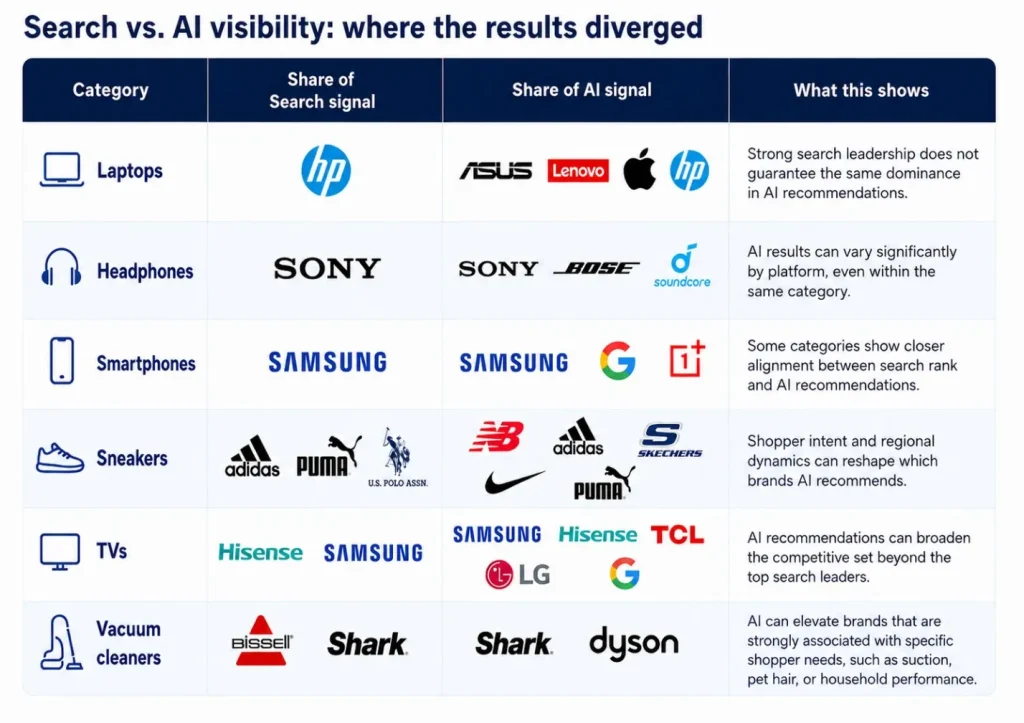
Laptops are a strong example. HP led strongly in Amazon Share of Search, but AI visibility was more mixed. ASUS appeared as one of the strongest laptop brands across Alexa for Shopping and GPT, while Lenovo, Apple, and HP gained strength in specific markets and phases. That means a brand can perform well in search while facing a different competitive set in AI-led product discovery.
Headphones showed a similar split, with Sony delivering highly consistent GPT visibility across markets and Prime Day phases. Alexa for Shopping was more variable, surfacing Bose, Sony, Soundcore, and some lesser-known brands at different points in the event.
Smartphones showed one of the clearest alignments between Share of Search and Share of AI, with Samsung leading strongly across both measures. Challenger brands still surfaced differently across AI environments, with Google gaining visibility in the US and OnePlus showing post-event strength in GPT results in the UK and UAE.
The takeaway is simple: brands need to measure search visibility and AI visibility separately. Strong search performance does not automatically guarantee strong AI recommendation performance.
3. Shopper intent is reshaping which brands get recommended
One of the biggest differences between keyword search and AI-led discovery is how the shopper expresses intent.
In traditional search, a customer may type “laptop,” “headphones,” “sneakers,” or “vacuum cleaner.” In AI shopping environments, the same customer may ask for a laptop for college and editing, headphones with strong battery life, sneakers with good cushioning, or a vacuum cleaner for pet hair and dust.
That changes the visibility equation.
AI systems are not only looking for keyword matches. They are interpreting shopper needs, comparing options, and surfacing products that appear relevant to a specific use case. This gives brands new ways to win, but only if their product content, specifications, reviews, pricing, availability, and promotional signals are strong enough to support the recommendation.
This was especially clear across categories such as laptops, smartwatches, sneakers, and vacuum cleaners. Garmin showed strong consistency in GPT smartwatch visibility, particularly around performance-oriented prompts. Shark performed strongly across vacuum cleaner AI visibility, especially where shopper needs were tied to suction, pet hair, and household use. In sneakers, AI visibility varied sharply by platform and market, with brands including New Balance, Adidas, Skechers, Nike, and Puma appearing depending on the prompt and phase.
For brands, product data needs to answer real buying questions, not just support a product detail page. The more specific the shopper intent, the more important it becomes for AI systems to understand why a product deserves to be recommended.
4. Regional visibility gaps remain a major Prime Day challenge
Prime Day 2026 also reinforced that visibility is highly regional. What works in one market does not automatically transfer to another.
Fashion was especially fragmented. In dresses, OFEEFAN and WIHOLL became more prominent in the US, AUSELILY led in the UK during key phases, and GORGLITTER showed much stronger dominance in the UAE. In sneakers, Adidas gained momentum in the US, PUMA gained Prime Day leadership in the UK, and U.S. Polo Assn. gained visibility in both the UK and UAE.
TVs also varied by market. Hisense showed broad strength, Samsung gained in the US, and TCL remained an important challenger in the UAE. Vacuum cleaners were more consolidated in the US and UK, with Bissell and Shark performing strongly, while the UAE remained more fragmented with no single brand dominating the market.
Prime Day requires more than a single global approach; brands need visibility strategies, assortment choices, competitive monitoring, and promotional plans that are tailored to how shoppers behave in each market.
5. Post-Prime Day visibility is now part of the event
Competition continued beyond the Prime Day window, with several categories seeing some of their most notable visibility shifts after the event had ended.
Sony strengthened sharply post-event in US headphones Share of Search. HP surged post-event in US laptop Share of Search. Samsung strengthened after Prime Day in smartphone visibility across multiple markets. In AI results, Garmin peaked post-event in GPT smartwatch visibility, while Shark surged in Alexa for Shopping vacuum cleaner visibility in the US.
This post-event movement matters because shoppers do not simply stop comparing once Prime Day ends. Many shoppers continue researching purchases they postponed, while others scan for leftover discounts, reassess competing options, or hold out to see if stronger deals appear once the main promotional window closes. Brands that stop monitoring too quickly risk missing a second wave of visibility movement. Brands need to plan for the post-event window before Prime Day begins, rather than treating it as a follow-up activity once the main promotional period ends.
What brands should do next
Prime Day 2026 shows that brands need to rethink how they measure and manage visibility during major retail events:
- Track traditional search and AI visibility separately. They are related, but they are not the same.
- Monitor visibility before, during, and after the event. A single snapshot will miss important shifts.
- Localize visibility strategies by market. Regional winners can look very different, even within the same category.
- Strengthen product content for intent-led discovery. AI systems need clear, credible product evidence to recommend a product confidently.
- Connect visibility signals with pricing, availability, promotion, reviews, and content performance to strengthen digital shelf visibility across both traditional search and AI-powered shopping environments.
The brands best positioned for the next major shopping event will be those that optimize beyond keywords and discounts, with a clear understanding of how shoppers discover, compare, and choose products across Amazon search and AI-powered recommendations.
Read the white paper: From search rank to AI recommendation
Prime Day 2026 offered a clear snapshot of where ecommerce visibility is heading. A strong search position remains important, but it no longer fully determines whether a brand is found, evaluated, or recommended.
As AI-powered shopping experiences become more influential, brands need to understand not only where they appear in search results, but whether AI systems can interpret their products, compare them accurately, and recommend them in response to specific shopper needs.
For brands thinking about AI search optimization, Prime Day 2026 is a clear reminder that visibility now depends on whether products can be found, understood, compared, and recommended across both search results and AI shopping assistants. For a deeper look at how AI search is changing digital shelf visibility, read our white paper, From Search Rank to AI Recommendation: The New Rules of Digital Shelf Visibility in AI Search. The paper explores how AI-generated answers, comparisons, shortlists, and recommendations are reshaping product discovery, and what brands can do now to become more visible, credible, and recommendation-ready.
Download the white paper
Join us at 1LoD The Financial Crime Summit – New York 2026
The 1LoD Financial Crime Summit – New York brings together senior leaders from global banks, regulators, and financial institutions for a one‑day forum focused on current challenges in financial crime risk and compliance. Attendees will hear from expert speakers, join discussions on key topics, and explore ways to strengthen financial crime controls.
eClerx is attending The Financial Crime Summit – New York 2026 to connect with industry professionals focused on anti‑money laundering (AML), sanctions, fraud risk, KYC, and broader financial crime prevention. This event offers an important opportunity to share insights, learn from peers, and explore practical ways to improve risk management and compliance approaches.
Event details
March 11, 2026
Pier Sixty, 60 Chelsea Piers, New York, NY 10011
9 AM – 6 PM (Eastern Time)
Here’s what you can expect at the event:
- Expert insights: Hear from senior leaders and practitioners on topics such as changing risk landscapes and regulatory expectations.
- Panel discussions: Learn through conversations on AML/KYC transformation, sanctions complexity, fraud risk, and emerging challenges.
- Roundtables: Join smaller group discussions to dive deeper into financial crime prevention strategies.
- Networking: Meet professionals from banks, regulators, and financial institutions to share experiences and connect.
Join us in New York on March 11 and meet the eClerx team to talk about how our solutions can help strengthen your financial crime compliance efforts and support your risk management goals.
Website: https://financialcrimenewyork.1lod.com/
Attending from eClerx

Jonathan Weiner
Head of Financial Crime Compliance Practice
Jonathan Weiner, Director, FCC & CLM Solutions, will join the panel “Navigating Fraud Risk Management & Traditional KYC” to share insights on how financial institutions can address evolving financial crime risks while avoiding added operational complexity.
The $2T personalization prize: Winning in the age of hyper-personalized commerce
Representing a $2 trillion market opportunity, hyper-personalization is set to transform the world of digital commerce for online brands.
By leveraging every customer interaction as data, digital retailers can better understand customer journeys, anticipate needs, and create tailored engagements to boost conversions and loyalty. If done right, it will help scale individualized customer experiences, while delivering a strong competitive advantage that can change the playing field in a crowded space.
In this white paper, we provide a strategic framework for implementing hyperpersonalization within your brand, recommending how C-suite executives and decision-makers can shift from generic experiences to intelligently tailored customer engagements.
Download the white paper
Improving loan servicing speed and accuracy for a global investment bank
eClerx partnered with a leading global investment bank to transform its North America loan servicing operations, improving process efficiency, reporting visibility, and service quality. Through a structured financial operations transformation program, the bank strengthened its loan lifecycle management capabilities, reduced operational backlogs, and created a more scalable operating model to support evolving business needs.
The investment bank manages a large and complex loan portfolio across North America, including syndicated loan servicing activities that require accurate record management, timely processing, regulatory compliance, and seamless coordination across multiple stakeholders. Effective loan servicing operations are critical to ensuring value-date accuracy, minimizing operational risk, and delivering consistent experiences for internal teams and clients.
Over time, increasing volumes, manual processes, and limited operational visibility made it challenging to maintain service levels. The bank needed a more efficient approach to banking process optimization—one that could improve accuracy, strengthen controls, and enable teams to respond quickly to changing demands.
The challenge
Managing loan servicing at scale requires a combination of specialized expertise, standardized processes, and real-time visibility into operational performance. For this global investment bank, several challenges were impacting day-to-day execution and client confidence.
- High volumes of past-due items accumulated, while clearance rates for scheduled activity reports (SARs) on value dates remained below expectations.
- Manual processes, inconsistent notices, and fragmented workflows created data gaps and reconciliation challenges.
- Peak periods, including month-end and quarter-end cycles, added further pressure, resulting in delays and increased operational risk.
- Limited reporting capabilities made it difficult for leadership teams to monitor productivity, identify bottlenecks, and take corrective action quickly.
- Lengthy approval processes and dependencies across control teams slowed resolution timelines, affecting service quality and client satisfaction.
The bank needed a scalable solution to improve operational efficiency in banking, enhance risk management, and create a more resilient loan servicing model.
Our strategy
eClerx designed a structured transformation program focused on people, processes, and technology to stabilize operations, improve accuracy, and enhance service delivery. The approach combined loan operations outsourcing expertise with process optimization capabilities to create a more agile and scalable operating framework.
1. Process optimization and workflow automation
eClerx introduced targeted improvements across core servicing processes to improve speed and consistency. A specialist task force was established to address high-volume past-due items, supported by clear daily, weekly, and monthly performance targets.
Agile volume-alignment methods were implemented to help teams manage fluctuations during peak periods, while hourly SAR tracking improved visibility into value-date performance and reduced operational spillover. Workflow automation and standardized processes helped reduce manual intervention, improve accuracy, and strengthen operational controls.
Regular governance reviews with senior leaders improved transparency, accountability, and decision-making across the servicing function.
2. Strengthening loan servicing capabilities
To support end-to-end loan lifecycle management, eClerx built a cross-trained team of senior analysts and consultants with more than 10 years of experience across platforms including LoanIQ, WSO, and ClearPar.
Leadership coverage was expanded with additional team leads and senior support aligned to North America working hours. New training and onboarding programs improved process consistency and accuracy, while career development initiatives helped strengthen employee engagement and retention.
This specialized delivery model enabled the bank to access experienced resources while building a more scalable approach to loan servicing operations.
3. Improving reporting and operational visibility
eClerx created a centralized view of operational performance, enabling teams to track productivity, identify recurring issues, and resolve exceptions faster.
Enhanced reporting capabilities provided near real-time reporting into key operational metrics, allowing leadership teams to make informed decisions, improve governance, and proactively manage operational risks.
The results
Within three quarters, the bank achieved measurable improvements across its North America loan servicing operations.
By combining process improvements, specialized expertise, and enhanced reporting capabilities, the bank established a more efficient and resilient operating model. Stronger governance, improved visibility, and better workflow management helped reduce risk, improve service levels, and enhance client satisfaction.
The results:
- 74% reduction in outstanding past-due items
- 24% improvement in SAR clearance on value dates
- Client service ratings improved from “Below Expectations” to “Meets Expectations”
- Stronger supervisory controls and more transparent reporting
- Resilient, cross-trained teams supporting high-volume cycles and end-to-end syndicated loan servicing
With these improvements in place, the bank created a scalable foundation for continued operational efficiency, regulatory compliance, and long-term performance improvement. The transformation demonstrates how financial services operations can benefit from a combination of domain expertise, banking process optimization, and technology-enabled execution.
eClerx’s AI-infused market intelligence suite optimizes the digital shelf for a global electronics giant
For almost a decade now, the client, a global MRO and electronics distributor, has partnered with us to build what has become one of the most advanced market intelligence, inventory, content optimization and pricing ecosystems in the industry.
As it expanded across the APAC and EMEA regions, they were unable to keep pace with the hyper-regional data required to track competition and scale operations.
Almost ten years ago, eClerx was signed up for a competitor monitoring project. This evolved into a long-term relationship, and today, eClerx is helping the client build a more advanced market intelligence ecosystem to streamline complexity and improve decision-making, including tools to implement product launches and actions at speed and scale.
The challenge
With its expansion globally and acquisitions in recent years, it became a challenge to manage the sprawling vendor base and sell over 1 million SKUs across 40+ countries.
The client needed a constant flow of data to ensure the positioning in an increasingly crowded market. Existing vendors could not keep pace with the volume of data required and struggled with anti-bot blocking from competitor websites. Commercial teams were working with fragmented data, while category and market teams lacked visibility into local assortment gaps and margin opportunities.
Expansive data needs:
- Anti-scraping measures enforced by competitors meant limited data volumes
- Pricing teams worked with siloed data, while category and market teams lacked visibility
- Challenges in seeing assortment gaps and commercial opportunities
Limited information led to slow decision-making:
- Fragmented data limited agility of pricing, category, and market teams
- Impacted ability for organization to scale into new regions
Our strategy
eClerx’s collaboration began with competitive intelligence activities, scraping pricing and stock availability data and providing actionable insights to inform pricing decisions. As trust grew, the client moved on to explore other avenues of engagement with eClerx. They were looking for a strategic partner who could scale the adoption of insights across various business functions.
“We didn’t want another vendor. We wanted a partner who would challenge our thinking and help us stay ahead of competitors. They’ve consistently acted like an extension of our team — not just supplying data, but helping us turn it into intelligence for commercial actions.”
eClerx began to support the foundational discounting frameworks, segmentation, customer-specific pricing, assortment optimization at a category-market level to streamline high margin sales and inventory planning.
Over the next few years, eClerx’s Market Intelligence suite has helped the client identify bottlenecks and gaps within the existing process. We proposed a hybrid solution combining the domain experience of industry experts and AI solutions to help the client take advantage of regional opportunities faster and at scale:
1. Establish a competitive intelligence process:
Starting our engagement by scraping pricing and stock availability data, our team worked to first provide the actionable insights needed to inform pricing decisions. Revenue impacts of 7-10% incremental sales in Germany and the UK alone were realised within the first 3 months of model development, leading to localized, yet scalable, range curation playbooks to be created.
2. Moving from static insights to in-time action:
We introduced product-matching and standardization for CPQ (quotations and tenders), enabling integrated quotation decisions. This was seamlessly integrated via an API with the client’s pricing platform in EMEA and in North America, allowing pricing decisions to flow directly into their CPQ processes.
3. Introducing AI-powered market intelligence:
Boosted by strong ROI, the partnership further deepened as the client adopted our AI-powered matching, content collection, and enrichment technologies across its group product and supplier management, always complemented by category SMEs from the industry in our managed services model.
4. Greater expansion into North America and APAC regions:
Once proven successful in EMEA, our team expanded our solution to the client’s U.S and APAC operations to improve both product assortment curation and stock and pricing decisions. Feeding data into their dynamic pricing program for over 250,000 SKUs weekly, the client was now able to make overnight decisions in response to market movements and impacts of macroeconomic factors such as tariffs.
The results
The implementation of eClerx’s Market Intelligence solutions empowered the client’s category teams and market leads to act faster and with greater confidence, helping them optimize local price positioning, better identify assortment gaps, and improve negotiations with suppliers.
Throughout the partnership, we’ve delivered advanced pricing segmentation models, elasticity analysis, discount optimization, and data-driven assortment planning through our category assortment intelligence methodology. These analytics were delivered holistically as they were operationalized into the client’s workflows and pricing systems. Content effectiveness measurement and benchmarking has also complemented the commercial actions taken, and decisions around what customized, customer persona-specific content meets the needs of end customers across industries, given the diverse 20+ categories serviced worldwide.
The implementation of Market Intelligence solutions empowered category teams and market leads to act faster and with greater confidence, optimizing local price positioning, identifying assortment gaps, and informing negotiations with suppliers.
The client has reported the following results:
- 100M+ product records scraped and delivered each month
- 140+ competitor websites analyzed across EMEA, APAC, and U.S. regions
- Dynamic pricing provided for over 250,000 SKUs each week
- ~11% customer demand uplift for new category assortments
At the core of this relationship is the client’s trust in eClerx, and our ability to perform as a strategic partner. Unlike previous providers, we offered embedded consultative support at no extra cost, bringing cross-industry best practices and deep expertise in MRO pricing, assortment, merchandising, matching and commercial analytics. Our teams worked collaboratively, delivering data and dashboards as well as co-developing frameworks and operating models that were later embedded into the client’s internal systems.
“Their intelligence powers our daily pricing decisions across 250,000 products in just one of our 40+ global market alone. The result is millions in incremental margin every year. It’s not just insight. It’s actionable insight that has operational, measurable impact.”
Our capability with speed, scale, and consistent high-quality data sets us apart from and has enabled the client to operate with unmatched market awareness, where decisions leveraging big data decisions is business critical.
Conclusion
The partnership continues to evolve with the adoption of our enterprise Generative AI content ecosystem, working hand in hand with our Market Intelligence solutions. This next phase focuses on using Generative AI to accelerate product matching, improve scraping efficiency, and deliver faster, more proactive insights to commercial teams by country market. Our AI platform is now being used not just to automate processes, but to enhance decision-making, helping the client remain ahead of competitors in an increasingly dynamic digital marketplace.
“We partnered with eClerx to help us streamline our product offer, taking a data-driven approach to removing, adding, retaining and improving the assortment of SKUs based on demand. Their ability to quickly formulate an analytics framework to address the problem at hand, bringing data science and technology to develop a scalable solution, enabled our category teams to spend less time trawling through data, and more time strategizing their range mix according to customer needs.”
What began as a project focused on scraping competitor pricing has grown into a decade-long strategic alliance transforming how the client prices, competes, and grows globally. With a combination of technology, industry expertise, SME-led managed services, and innovation in AI, our partnership has delivered sustained commercial impact and set a new standard for data-driven decision-making in the MRO and distribution industry.
Adobe Firefly: Reimagining creative output with AI for global finance and luxury brands
eClerx designed a unique solution for a challenge faced by organizations across industries: how to scale creative production without sacrificing brand integrity, compliance, or control. By combining Adobe Firefly’s GenAI with FLUiiD4, its proprietary centralized asset management system, eClerx modernized creative production into a controlled, scalable ecosystem.
The result? 40% reduced production costs, 3X faster campaign deployment, and no licensing risks at all.
Global finance and luxury brands operate in environments where creative speed must operate alongside strict governance, licensing controls, and regulatory scrutiny. As the demand for digital content continues to grow, maintaining consistency and control across markets is more of a strategic challenge than an operational one.
Rather than treating content creation and asset management as separate workflows, eClerx’s novel approach unified them into a single, governed ecosystem, allowing teams to move faster without compromising compliance, consistency, or control across regions. The engagement demonstrated how Adobe Firefly, when deployed within a creative ecosystem, can become a core enabler of enterprise-grade creative transformation.
The challenge
A number of eClerx’s enterprise clients are global leaders in their industries. Despite a strong market presence and mature creative teams, they were facing similar problems: creative work that was becoming harder to manage, inconsistent messaging across regions or teams, and complex approval processes.
Over time, this led to inefficiencies, slowing down campaigns and increasing costs and risks. Teams used assets that were not current, compliant, or aligned with new brand guidelines. They spent time recreating assets that already existed but could not be found or struggled to verify usage rights.
Asset management gaps:
- Images and videos stored in many locations
- Teams could not easily find or reuse content
Brand consistency issues:
- Old visuals reused after brand updates
- Different regions using different styles
Compliance and licensing risks:
- Unclear image rights and usage limits
- No single place to verify permissions
Our strategy
What these organizations needed was not just faster content creation, but a new operating model for creative production. eClerx designed a model that embedded safety, governance, and reuse directly into the creative process.
1. Added safe, controlled AI creation
eClerx introduced Adobe Firefly as a controlled creative layer, not a free-for-all. Teams could generate new, on-brand visuals using AI models trained on licensed and approved content.
Every image was safe for commercial use from day one. This gave teams speed, without adding risk.
2. Built a single source of truth for assets
Next, eClerx implemented its proprietary FLUiiD4 system as a centralized home for all creative content. Every new image was automatically cataloged, labeled and tagged. Images were tracked for usage rights, marked for regional applicability, and linked to approval status. This eliminated guesswork and ensured that the right images were used at the right time.
3. Connected creation and governance
Shifting from treating AI creation and asset management as separate workflows, eClerx tightly integrated both into one system. Instead of having to choose between creative speed or governance, teams could now easily generate risk-free visuals, store and share via FLUiiD4, see rights and approvals across regions.
By tightly integrating generative creation with asset governance, this solution enabled teams to quickly access approved assets, reuse content across regions, and ensure that every campaign used visuals that were safe, current, and aligned with brand standards.
The results
By removing guesswork from creative workflows, these enterprises transformed content creation into a scalable, auditable, and repeatable process.
Teams were able to move faster while significantly reducing duplication, risk, and manual effort. Brand visuals became more consistent across markets, and content could be reused across campaigns and regions.
- 100% alignment with updated brand identities
- 40% lower production costs by reducing reliance on new photo shoots
- 3× faster campaign deployment through better asset readiness
- Zero licensing infringements
- Stronger consistency across regions
- Less duplication and manual work
With a governed creative foundation in place, these brands now have a scalable, future-ready ecosystem that supports growth, personalization, and innovation without sacrificing control or compliance.
As an Adobe Gold Solution Partner, eClerx is able to implement the full Adobe Suite. For this engagement, the work deployed Adobe Firefly for safe creative generation, combined with FLUiiD4, eClerx’s proprietary centralized asset management system, to provide a single, trusted system for managing and distributing creative assets.
Strengthening FCC processes and controls to meet regulatory expectations for a global asset manager
A leading UK-based savings and investment group with nearly £350B in assets across asset management, insurance, pensions, and wealth solutions partnered with eClerx to implement a remediation/transformation program to enhance their FCC policy, process/controls, and technology suite. Leveraging deep expertise across our FCC Centers of Excellence and proprietary solutions, we eliminated backlogs with 99% quality and reduced BAU volumes by 20%+, while streamlining workflows for enhanced efficiency.
Established over 85 years ago, the client has a long-standing heritage in delivering investment solutions across public and private markets. The organization manages assets on behalf of institutional and individual investors worldwide, navigating complex markets with a long-term perspective.
The challenge
In such a complex landscape, the client is committed to conducting its own regular compliance checks. An internal audit revealed that existing operational processes, procedures, and controls required overhauling to be better prepared for regulatory adherence. Some of their most crucial areas were:
- Misclassified historic cases: Thousands of historical cases needed re-examination, requiring substantial operational and staffing resources.
- Ineffective procedures and control: Outdated procedures resulted in inconsistent decision-making, unclear investigator guidance, and greater exposure to risk and regulatory default.
- Technology constraints: Limited automation, poor case management tools, and fragmented data flows heightened the risk of compliance gaps and controls.
To implement the group-wide remediation/transformation program, the client required a partner with specialized global FCC expertise, technology, and surge capacity to deliver high-quality outcomes against tight timelines.
They partnered with eClerx for an enhancement program targeting gaps and inefficiencies that were rapidly increasing compliance risk, creating significant backlogs, and jeopardizing the firm’s ability to meet regulatory expectations.
Our strategy
After analyzing our client’s program needs, we committed to three strategic objectives across their businesses:
- Remediate ~60K anticipated historic cases
- Provide ongoing support to manage spikes in BAU post remediation
- Deploy the policy, process/controls, and technology changes in production for ongoing case management
Our delivery strategy combined knowledge of the client’s process and systems with our FCC Center of Excellence best practices, governance, and a QA framework to set the foundation.
Ahead of the program, we proactively onboarded 42 team members in approximately 2–3 weeks and further scaled to 120+ members within 6 weeks to complete higher-than-anticipated volumes (450%+) and changes. Deploying these resources across Manila, Spain, and India, we reinvestigated all historic cases based on revised policies, workflows, and controls that were implemented on a forward fix basis. Our flexible operating model ensured the client received scalability without long-term cost commitment.
By leveraging eClerx Compliance Manager, our proprietary CLM platform, and other tailored assets/toolkits for tracking metrics, management information, reporting, and workforce management, we ensured the client had complete visibility of progress, quality, and cost throughout the program and for BAU activities.
The results
Our solution, encompassing ops, tech, and FCC expertise, successfully closed risk gaps to meet the client’s audit findings and response to the FCA.
- Remediated 100% of cases on time with 99%+ quality 2 weeks ahead of schedule despite a 450% volume surge
- Reduced BAU volume by 20%+ through threshold optimization
- Reduced average handling time by 15%+ using eClerx Compliance Manager powered by EDOS, our proprietary tool for automated data sourcing
The program has now transitioned to phase 2, where we will leverage learnings and targeted objectives to improve client data through remediation and cleansing, implement further workflow enhancements and automation, and evaluate the effectiveness of processes and controls.
Signals in motion: Using multimodal AI to interpret brand engagement in real time
Today’s digital experiences are more layered, emotional, and fast moving than ever before. Marketers and analysts can no longer afford to rely solely on clickstream or time-on-page data to understand what’s truly resonating. Customers interact through multiple modes – tapping, scrolling, hovering, watching and each of these actions carries subtle intent.
At eClerx, we’re helping brands transform customer experiences by monitoring these interactions and allowing our clients to scale digital commerce through real time personalization.
Beyond the click: Why single-source clickstream data isn’t enough anymore
Clickstream data is a great starting point—it shows where users click, which pages they visit, and how long they stay. But it’s only one piece of a much bigger puzzle.
To truly understand your audience, you need to go deeper. Here’s why:
- Discover the “why” behind the click: A click alone doesn’t reveal intent. Was the user confident and engaged, or confused and uncertain? Did they click by choice or by accident?
- See the moments between clicks: Scroll patterns, cursor movement, hover pauses, and even “rage clicks” reveal emotion and engagement levels that clickstream alone can’t capture.
- Replace assumptions with clarity: When data lacks depth, it’s tempting to fill the gaps with guesswork. Richer behavioral insights prevent bias, ensuring decisions are grounded in reality—not assumptions.
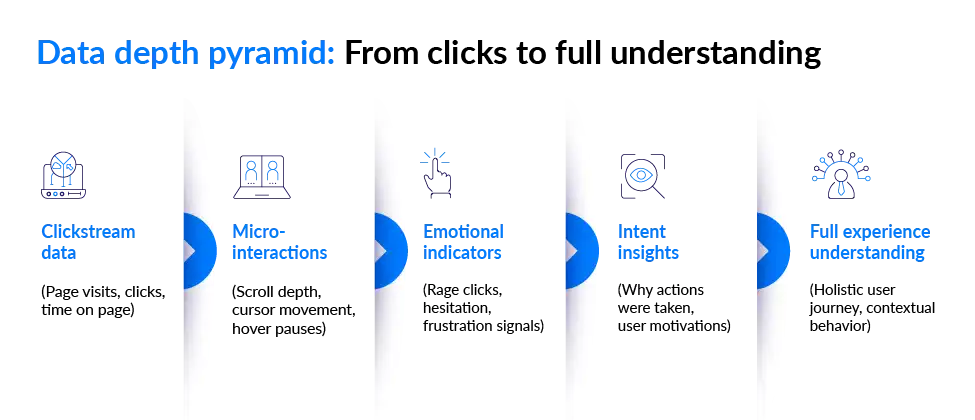
When you combine clickstream data with deeper behavioral signals, you move from simply tracking actions to truly understanding experiences – and that’s where transformation happens.
For example: eClerx partnered with a banking organization to help reduce the 65% bounce rate on its account comparison page. Click data alone didn’t reveal the issue. When we added scroll depth and rage click tracking, it became clear users were repeatedly interacting with a non-clickable element mid-page, then leaving. Once CTAs were repositioned and clarified with sub-texts, the bounce rate dropped and engagement improved significantly.
Signals in motion: Real-time experience mapping
What if your analytics could detect frustration before a user even bounces? Multimodal AI lets you build real-time experience maps that combine scroll depth, dwell time, video watch behavior, cursor velocity, and eye tracking. These signals feed into models that predict drop-off likelihood, interest level, or conversion probability – while the user is still active on-site.
This isn’t just attribution, it’s intervention.
Imagine being able to suppress exit modals for high-intent users, but proactively offer support to those showing signs of confusion.
A durable goods retailer used GA4 scroll depth and video engagement data to optimize their product category landing page. By identifying key sections where users paused or dropped off, they restructured content flow and repositioned video explainers higher on the page. The result? A 17% drop in bounce rate and a 22% lift in click-throughs to product detail pages.
Predictive CX models: A new marketing arsenal turning insights to action
Predictive modelling becomes more accurate when data types contextualize each other. For example, a user scrolling deeply but never clicking could signal informational intent, while video engagement paired with gaze analysis might reveal emotional resonance with a product.
Multimodal AI isn’t just interpretive—it’s predictive. The goal is to move from “what happened” to “what will happen” and “what should we do about it?” If a user has a history of fast-scrolling, rage clicking, and bouncing within 30 seconds, AI can flag them in real time and trigger smoother experiences—be it simplified UI, or escalated chat support
We have seen multiple use cases across user journey where businesses can implement these models and make multi-million-dollar ROI
- Churn predictors: Users who repeatedly pause videos and revisit pricing pages
- Conversion likelihood scores: Based on depth of interaction across modalities
- Personalization engines: Adapt UI, content, offers in real time
From integration to impact: Putting multimodal AI to work
Typically, a multimodal engine aimed at real time personalization works by unifying all behavioral data in BigQuery or a CDP, then enriching it with session replays or chat logs.
From there, machine-learning models are trained to segment users based on engagement quality and trigger timely interventions—like personalizing product banners or reordering content blocks or triggering exit modals based on intent prediction.
Operationalizing multimodal AI
With the right setup, multimodal AI stops just being a dashboard feature, enabling marketers to shift from reactive reporting to proactive personalization, offering support or content dynamically, based on micro-signals.
For example, a B2C client used scroll + click + chatbot data to identify and recover 18% of high-exit users from the cart page.
To get started, a business can begin by identifying clear use cases before scaling up for optimal ROI, like reducing cart abandonment or improving lead form completions.
The next step would be to feed in a mix of engagement signals—such as video completion rates, scroll velocity, and chatbot queries.
Finally, apply the AI outputs to personalize journeys.
Why this matters now: The competitive edge
Experience has overtaken price and product as the key battleground. AI-driven engagement insights are helping brands deliver emotionally resonant and in-the-moment responses.
Leading brands are embedding AI into decision systems—fueling faster learning cycles and better personalization. Waiting means falling behind.
And with the end of third-party cookies, deeper interpretation of on-site behavior—like gaze, scroll depth, or video replays—will be the holy grail for intent modeling.
Making it actionable: Cross-team buy-in for smarter engagement
To make multimodal AI actionable, cross-functional collaboration is key. Product, marketing, and analytics teams must work together to:
- Align on key engagement signals
- Define what ‘good’ engagement looks like
- Build real-time triggers and feedback loops
If you’re still relying on single-source engagement metrics, you’re missing the full picture. Multimodal AI is not about replacing marketers—it is about empowering them with better foresight and ability to make smarter decisions faster.
Ready to turn micro-signals into macro impact? Click the link below to book a free consultation.
Let’s chat. Book a free signal health check consult to see how we can apply these frameworks and get the most out of your investment.


