Blog | 13 mins read
October 16, 2026

Customers leave trails with every interaction they have with a brand. A website visit, product search, purchase, service call, chatbot conversation, email response, app session, and even a product review can reveal something about what a customer needs, expects, or finds frustrating.
This is where customer data analysis comes in. When customer information is brought together and analyzed effectively, businesses can move beyond simply knowing what customers did.
In this guide, we’ll explore what is worth analyzing, the metrics that tell you something useful, the places where customer data analysis goes wrong, and how AI is changing the job.
Key takeaways
- Understand what customer data analysis is and why it matters for modern businesses
- Learn the different types of customer data businesses can analyze
- Understand the customer data analysis process, from data collection to actionable insights
- Explore the four types of customer analytics: descriptive, diagnostic, predictive, and prescriptive
- Discover the key metrics used to measure customer behavior and performance
- Learn how customer data analysis improves customer experience, retention, acquisition, and revenue
- Understand the common challenges around data quality, privacy, security, and fragmented customer data
- Find out how AI and machine learning are reshaping customer data analysis
- Learn the best practices behind an effective customer data analytics strategy
- Explore how eClerx helps businesses turn customer data into business-ready insights
What is customer data analysis?
Customer data analysis is the practice of examining customer behavior to identify buying patterns, understand behavior, and support better business decisions.
It answers questions such as:
- Who are our customers?
- What are they buying?
- How do they interact with our brand?
- Where are they dropping off?
- What problems are they experiencing?
- Which customers are likely to leave?
- What can we do to improve their experience?
However, it is important to distinguish between customer data and customer analytics.
- Customer data is the raw information a business collects. This could include a customer’s purchase history, demographic information, website activity, service interactions, survey responses, or product usage.
- Customer insights are what a business learns from that information. For example, a brand may know that cart abandonment in the previous month was 68%. But if the brand understands that abandonment jumped to 68% the moment shipping costs appeared at checkout, it is considered an insight.
Having the right data doesn’t always mean that the brand is doing anything with it. In eClerx’s Mind the Gap marketing research, 78% of marketing leaders said that after years of investment, their martech stacks still did not support their business goals, and 75% admitted they make investment decisions based on partial data. Only 35% use real-time insights to optimize anything.
Why is customer data analysis important?
Customer analysis turns insights and data into actionable recommendations. With analytical tools, today we can study segmentation, churn modeling, and marketing measurement. Businesses invest in it to cover these four key questions:
- Which customers are worth acquiring?
- Which are about to leave?
- What stops people from converting?
- Where is money being wasted?
McKinsey research found that 71% of consumers expect companies to deliver personalized interactions, and 76% get frustrated when that does not happen. Personalization at that level is not possible without analysis behind it.
Customer data analysis offers six significant benefits:
- A sharper read on customer needs: Customers may say they like something, but behave in a contradictory way. Analysis shows you the truth.
- Personalization that holds up: When a brand shares offers with clients, real segmentation, based on behavior rather than job title or age bracket is what makes it relevant or irrelevant.
- Better customer experience: Friction shows up in the data long before a complaint is registered. Drop-off points, repeat contacts, and abandoned journeys are all measurable, which makes customer experience optimization something you can plan rather than improvise.
- Lower churn and stronger retention: At-risk customers behave differently for weeks before they leave. If brands can spot the pattern on time, they can do something to intervene.
- Marketing and sales that spend better: Attribution and media mix analysis reveal which channels genuinely drive revenue and which are not working.
- Data-backed decision-making: Data-driven analysis gives business leaders evidence to work with. Instead of asking what customers might be doing, teams can use data to understand what is actually happening.
What types of customer data can businesses analyze?
Five data types cover the majority of enterprise use cases, and each answers a different kind of question.
| Data type | What it covers | Example |
|---|---|---|
| Demographic | Age, gender, location, income band, job role, household size | A bank finds that customers aged 25–34 in metro cities open accounts almost entirely through mobile |
| Behavioral | Clicks, page views, session length, feature usage, email opens, support contacts | A SaaS product sees that users who skip onboarding step three churn at three times the average rate |
| Transactional | Purchases, order value, frequency, refunds, payment method, subscription history | A retailer identifies that customers who buy twice in the first 60 days rarely lapse in the first year |
| Customer feedback | Surveys, NPS and CSAT verbatims, reviews, chat transcripts, call recordings | A telecom provider traces a CSAT dip to a single confusing line on the monthly bill |
| Psychographic | Values, interests, lifestyle, motivations, attitudes | A fashion brand learns that its highest-spending segment buys on sustainability credentials instead of pricing |
| First-party and third-party | Data collected directly through your own website, app, CRM, transactions, and support channels, versus data bought from external aggregators | A subscription business builds its segments from its own billing and app data, then buys third-party firmographics to fill in company size for B2B accounts |
Worth adding to the list: Zero-party data, meaning preferences customers hand over deliberately through preference centers, quizzes, and profile settings. It is small in volume and unusually high in value.
How does customer data analysis work?
eClerx’s research calls the space between generating insight and acting on it the Activation Gap. It is the single most common reason analytics investment fails to show up in revenue.
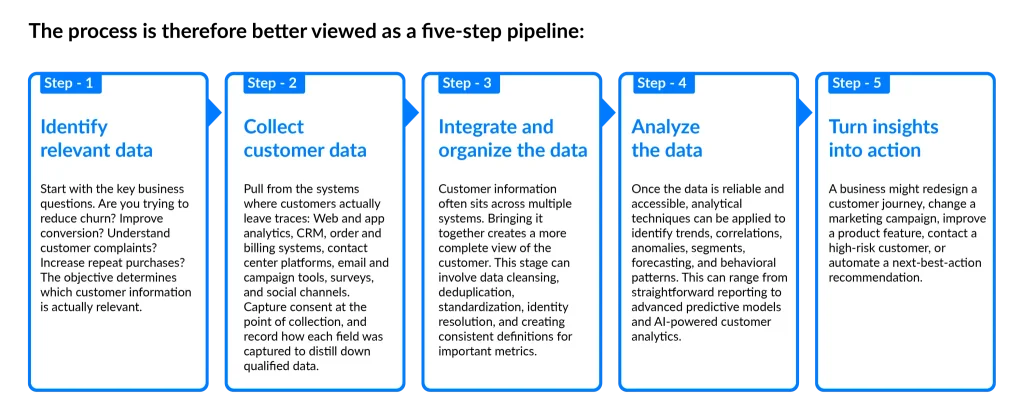
If you are working out how to analyze customer behavior from scratch, here are the five stages to consider:
Step 1: Identify relevant data
Start with the key business questions. Are you trying to reduce churn? Improve conversion? Understand customer complaints? Increase repeat purchases? The objective determines which customer information is actually relevant.
Step 2: Collect customer data
Pull from the systems where customers actually leave traces: Web and app analytics, CRM, order and billing systems, contact center platforms, email and campaign tools, surveys, and social channels. Capture consent at the point of collection, and record how each field was captured to distill down qualified data.
Step 3: Integrate and organize the data
Customer information often sits across multiple systems. Bringing it together creates a more complete view of the customer. This stage can involve data cleansing, deduplication, standardization, identity resolution, and creating consistent definitions for important metrics.
Step 4: Analyze the data
Once the data is reliable and accessible, analytical techniques can be applied to identify trends, correlations, anomalies, segments, forecasting, and behavioral patterns. This can range from straightforward reporting to advanced predictive models and AI-powered customer analytics.
Step 5: Turn insights into action
A business might redesign a customer journey, change a marketing campaign, improve a product feature, contact a high-risk customer, or automate a next-best-action recommendation.
The process is therefore better viewed as a five-step pipeline:
Types of customer analytics
Customer analytics can generally be grouped into four categories.
| Type of analytics | Descriptive analytics | Diagnostic analytics | Predictive analytics | Prescriptive analytics |
|---|---|---|---|---|
| What does it solve? | What happened? | Why did it happen? | What is likely to happen? | What should we do about it? |
| How does it solve? | Examines historical data to understand what has already happened | Investigates the reasons behind an outcome | Uses historical patterns to estimate future behavior | Recommends an action based on the investigation |
| Example | Monthly sales Website conversion rates Customer churn Average order value Customer service volumes | If churn increases, diagnostic analysis may find that it was because of repeated service issues | Churn probability Likelihood to purchase Expected lifetime value Demand forecasts | Instead of simply identifying customers who are likely to churn, it might recommend which customers should receive an offer, service intervention, or personalized communication |
Together, these four approaches help businesses move from reporting the past to making better decisions about the future.
Key metrics for customer data analysis
| Metric | What it tells you | How it is calculated |
|---|---|---|
| Customer Acquisition Cost (CAC) | What you pay to win one new customer | Total sales and marketing spend ÷ new customers acquired |
| Customer Lifetime Value (CLV/LTV) | Total profit a customer generates across the relationship | Average order value × purchase frequency × customer lifespan × margin |
| Customer churn rate | The share of customers leaving in a period | Customers lost ÷ customers at the start of the period |
| Customer retention rate | The share you keep, and the flip side of churn | (Customers at end − new customers) ÷ customers at start |
| Conversion rate | How efficiently traffic or leads become customers | Conversions ÷ total visitors or leads |
| Average Order Value (AOV) | How much customers spend per transaction | Total revenue ÷ number of orders |
| Net Promoter Score (NPS) | Willingness to recommend you, as a loyalty proxy | % promoters − % detractors |
| Customer Satisfaction (CSAT) | Satisfaction with a specific interaction | Satisfied responses ÷ total responses × 100 |
Common challenges in customer data analysis
Most analytics programs stall for the same handful of reasons.
- Data silos: Customer information may remain in CRM, eCommerce teams, marketing teams, contact centers, finance teams, and other systems that were not designed to work together. This makes it difficult to create a consistent view of the customer. This can be fixed with a unified profile with clear ownership, built once and reused everywhere, rather than a new extract for every project.
- Poor data quality: Gartner estimates that poor data quality costs organizations an average of $12.9 million a year, and in eClerx’s marketing research, 34% of leaders named data quality as their single biggest barrier. Validate at the point of capture, run targeted remediation on the existing base, and give data governance a named owner.
- Fragmented customer identity: The same person appears as a web cookie, an email address, a loyalty number, and a support ticket, and none of them are linked. The fix? Identity resolution before modeling, not after.
- Legacy systems: Older platforms may not integrate easily with modern analytics environments. Replacing them may also be expensive or disruptive, making integration and modernization an important part of the data strategy.
- Data privacy and security: GDPR, CCPA, and India’s DPDP Act govern what you may collect, how long you may keep it, and what customers can demand you delete. Businesses must consider consent, access controls, security, regulatory requirements, retention policies, and appropriate use of data throughout the analytics lifecycle.
- Insight that never becomes action: The Activation Gap again. Even the best analytics, when they are not moved into workflows, will not be able to change anything downstream. Instead, make sure that every insight has an owner, a system it flows into, and a metric it is expected to move.
That last one deserves more attention. Data quality problems are visible and get funded, but activation problems are often invisible, because because everything looks busy.
How AI is transforming customer data analysis
The best customer data analysis methods can now run continuously, analyzing far more variables and patterns than an individual analyst could realistically process in a week.
Some common applications include:
- AI-powered customer segmentation: Machine learning can identify customer groups based on behavioral patterns rather than relying only on predefined demographic categories.
- Predictive churn analysis: AI models can identify combinations of behaviors that indicate a customer may be at risk of leaving, allowing businesses to intervene earlier.
- Personalized recommendations: Recommendation models can use previous purchases, browsing behavior, preferences, and contextual signals to determine which products, content, or offers may be most relevant.
- Customer behavior prediction: AI can identify patterns that may indicate future purchases, engagement changes, or service needs.
- Sentiment analysis: AI can analyze customer conversations, reviews, surveys, and support interactions to identify sentiment and recurring themes at scale.
- Real-time customer insights: Instead of waiting for a monthly report, businesses can use streaming and near-real-time analytics to identify changes in customer behavior and respond more quickly.
- Next-best-action recommendations: AI can combine customer context, business rules, historical outcomes, and predictive models to recommend the next action for a customer or an employee.
Best practices for customer data analysis
Organizations that get value out of this work tend to follow the same path:
Step 1: Define clear business objectives: Write down the decision that each insight is meant to inform, and assign an owner.
Step 2: Integrate customer data sources: Bring web, app, CRM, transaction, support, and feedback data into a single trusted profile, with identity resolution doing the connecting.
Step 3: Maintain data quality: Validate at capture, monitor for drift and decay, and clean the existing base rather than working around it.
Step 4: Use metrics that match the objective: For instance, a retention program needs churn, retention, and CLV. An acquisition program needs CAC, conversion, and payback period.
Step 5: Apply AI and predictive analytics where volume justifies it: Start with a use case that has a clear owner and a measurable outcome, such as churn prediction or next-best-action, rather than a platform-wide rollout.
Step 6: Protect customer data and privacy: Collect what you need, document consent, set retention limits, and restrict access by role.
Step 7: Turn insights into measurable actions: Push findings into the systems where work happens, and agree upfront which metric each action is expected to move.
Step 8: Keep optimizing the strategy: Review what actually changed as a result of analysis each quarter. Analytics strategies therefore need regular review and refinement.
The future of customer data analysis
Customer analytics is moving from periodic reporting toward continuous, increasingly automated decision-making. Here’s how:
- AI-powered customer analytics: AI will help businesses analyze large volumes of customer data faster, identify behavioral patterns, and generate actionable insights at scale.
- Predictive analytics: Predictive models will help businesses anticipate churn, purchase intent, customer needs, and other likely outcomes before they happen.
- Real-time customer insights: Real-time analytics will enable businesses to respond to changing customer behavior, emerging issues, and engagement signals as they occur.
- Generative AI: GenAI will make customer data easier to explore by enabling teams to ask questions in natural language, summarize findings, and generate insights faster.
- Hyper-personalization: Businesses will use behavioral, transactional, and contextual data to deliver more relevant offers, content, recommendations, and experiences to individual customers.
- Privacy-first analytics: As customer data use expands, businesses will need to balance personalization with strong data privacy, security, consent, and governance practices.
- Automated customer decision-making: AI and decision engines will increasingly automate actions such as next-best offers, customer outreach, recommendations, and service interventions.
Conclusion: How eClerx can help
Customer data is valuable only when businesses use it to make better business decisions. AI and advanced analytics can help you predict what may happen next and even recommend actions that might help. But achieving those outcomes requires connected data, reliable processes, relevant metrics, advanced analytical capabilities, and a clear path from insight to action.
The benefits of customer data management extend across the organization, from better customer experiences and personalization to stronger retention, more effective marketing, and better business decisions.
That combination is where eClerx works best. We help organizations join fragmented customer data into a usable profile, apply AI and advanced analytics to it, and connect the output to the teams and systems that act on it.
Some of our proprietary solutions include CX360 for journey analytics, and QA360 for interaction quality and sentiment. Explore eClerx‘s capabilities, or talk to our team about where your own activation gap sits.
Frequently Asked Questions
What are the different types of customer data?
The main categories are demographic data (age, location, income, job role), behavioral data (clicks, sessions, feature usage, support contacts), transactional data (purchases, order value, frequency, refunds), customer feedback (surveys, NPS and CSAT responses, reviews, call transcripts), and psychographic data (values, interests, motivations).
What are the four types of customer analytics?
Descriptive analytics tells you what happened. Diagnostic analytics tells you why it happened. Predictive analytics estimates what is likely to happen next. Prescriptive analytics recommends what to do about it. Most organizations are strongest on descriptive and weakest on prescriptive, which is also where the commercial value is highest, because it is the only one that ends in an action.
What metrics are used in customer data analysis?
The core set is Customer Acquisition Cost (CAC), Customer Lifetime Value (CLV), churn rate, retention rate, conversion rate, Average Order Value (AOV), Net Promoter Score (NPS), and Customer Satisfaction (CSAT).
How does AI help with customer data analysis?
AI can process large volumes of customer information, identify behavioral patterns, predict outcomes, segment customers, analyze sentiment, personalize recommendations, and support next-best-action decisions. This can make customer analytics faster, more scalable, and more predictive.
What are the challenges of customer data analysis?
Common challenges include data silos, poor data quality, fragmented customer information, legacy technology, privacy and security requirements, inconsistent metrics, and difficulty converting analytical findings into measurable business actions.
How can customer data analysis improve customer experience?
It shows you where the experience actually breaks rather than where you assume it does. It can identify points of friction across the customer journey, reveal recurring service issues, improve personalization, predict customer needs, and help businesses prioritize changes that can improve satisfaction and loyalty. Customer journey analytics can be particularly useful when interactions span multiple digital and physical channels.
What tools are used for customer data analysis?
Most stacks combine a few categories: Customer data analysis tools such as Google Analytics, Adobe Analytics, or Mixpanel; a CRM such as Salesforce; a customer data analytics platform or CDP for unifying profiles; a warehouse or lakehouse such as Snowflake, BigQuery, or Databricks; BI and visualization tools such as Tableau or Power BI; and AI-driven platforms for sentiment, quality, and journey analysis, including eClerx’s QA360 and CX360.
Featured insights