Blog | 8 mins read
July 3, 2026
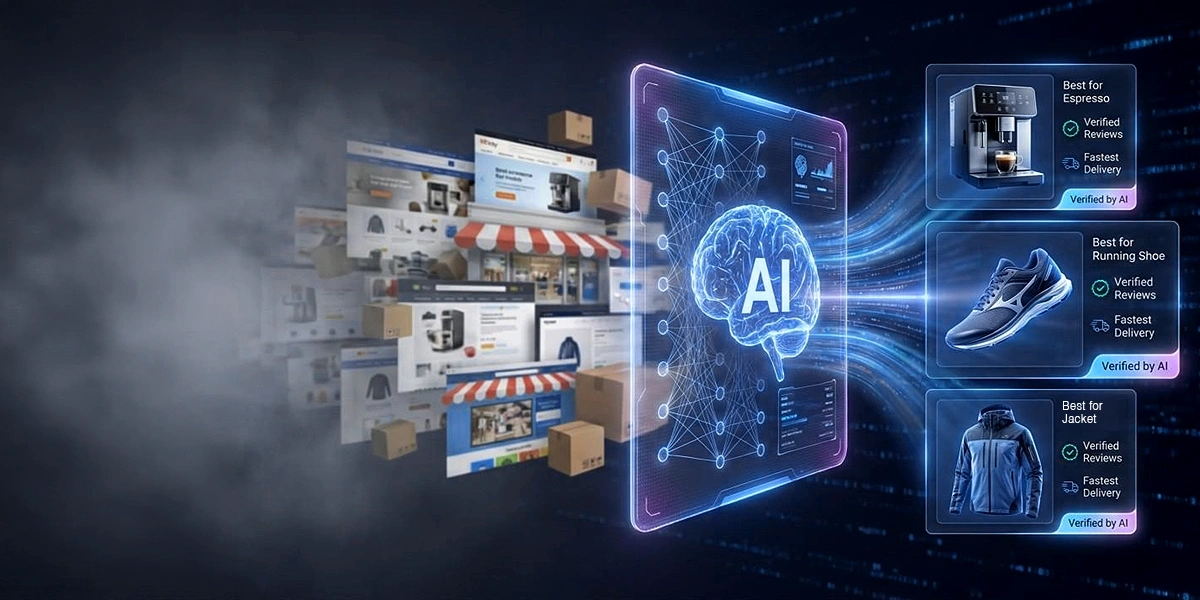
Amazon Prime Day 2026 showed that ecommerce visibility is becoming harder to measure through search rankings alone. Brands are still competing for traditional Amazon SEO performance, but they are also competing to appear in AI-powered shopping results when shoppers ask more specific, intent-led questions.
That shift matters because AI shopping assistants and AI-powered product discovery do not always mirror traditional search results. A brand can lead in Share of Search and still face a different competitive set in Share of AI, especially when tools such as Alexa Shopping and GPT interpret shopper intent, compare options, and recommend products based on specific needs.
Our Prime Day 2026 analysis looked at two visibility signals: Share of Search and Share of AI. Together, the findings show how AI in e-commerce is changing digital shelf visibility and why brands need to understand where they appear, how they are evaluated, and whether they are recommendation-ready. The key takeaway is clear: Prime Day visibility is no longer one leaderboard. It is a connected, fast-moving visibility system across search, AI, category, market, and shopper intent.
1. Traditional search still creates strong category leaders
Amazon search remains a critical battleground during major retail events. Across several categories, Prime Day 2026 produced clear search visibility leaders.
In electronics, Sony remained the most consistent headphones brand across the US, UK, and UAE, while Samsung dominated smartphone visibility across all three markets. HP emerged as the strongest laptop performer, leading across the US, UK, and UAE during Prime Day and gaining significant post-event visibility in the US. In TVs, visibility shifted toward Hisense and Samsung, with Hisense showing strong cross-market consistency and Samsung strengthening in the US.
In home and kitchen, Roborock led robot vacuum visibility across all three markets throughout Prime Day, while Shark delivered the strongest cross-market performance in vacuum cleaners, particularly in the UK.
The takeaway is that traditional search visibility still carries enormous commercial value, and being present, prominent, and competitive in Amazon search remains essential during major retail events. Prime Day 2026 also showed that search visibility alone is no longer enough.
2. AI recommendations do not simply mirror search rankings
The Share of AI findings showed a different competitive picture. AI-powered recommendations do not simply mirror Amazon search rankings; they create an additional layer of visibility where brands can gain, lose, or defend shopper consideration.
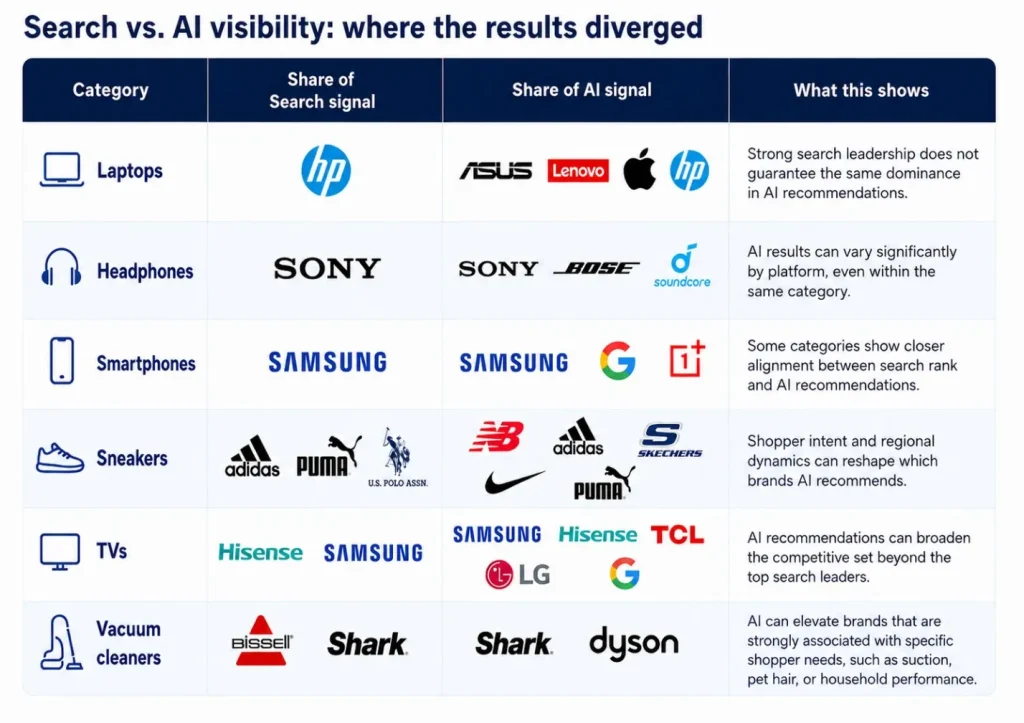
Laptops are a strong example. HP led strongly in Amazon Share of Search, but AI visibility was more mixed. ASUS appeared as one of the strongest laptop brands across Alexa for Shopping and GPT, while Lenovo, Apple, and HP gained strength in specific markets and phases. That means a brand can perform well in search while facing a different competitive set in AI-led product discovery.
Headphones showed a similar split, with Sony delivering highly consistent GPT visibility across markets and Prime Day phases. Alexa for Shopping was more variable, surfacing Bose, Sony, Soundcore, and some lesser-known brands at different points in the event.
Smartphones showed one of the clearest alignments between Share of Search and Share of AI, with Samsung leading strongly across both measures. Challenger brands still surfaced differently across AI environments, with Google gaining visibility in the US and OnePlus showing post-event strength in GPT results in the UK and UAE.
The takeaway is simple: brands need to measure search visibility and AI visibility separately. Strong search performance does not automatically guarantee strong AI recommendation performance.
3. Shopper intent is reshaping which brands get recommended
One of the biggest differences between keyword search and AI-led discovery is how the shopper expresses intent.
In traditional search, a customer may type “laptop,” “headphones,” “sneakers,” or “vacuum cleaner.” In AI shopping environments, the same customer may ask for a laptop for college and editing, headphones with strong battery life, sneakers with good cushioning, or a vacuum cleaner for pet hair and dust.
That changes the visibility equation.
AI systems are not only looking for keyword matches. They are interpreting shopper needs, comparing options, and surfacing products that appear relevant to a specific use case. This gives brands new ways to win, but only if their product content, specifications, reviews, pricing, availability, and promotional signals are strong enough to support the recommendation.
This was especially clear across categories such as laptops, smartwatches, sneakers, and vacuum cleaners. Garmin showed strong consistency in GPT smartwatch visibility, particularly around performance-oriented prompts. Shark performed strongly across vacuum cleaner AI visibility, especially where shopper needs were tied to suction, pet hair, and household use. In sneakers, AI visibility varied sharply by platform and market, with brands including New Balance, Adidas, Skechers, Nike, and Puma appearing depending on the prompt and phase.
For brands, product data needs to answer real buying questions, not just support a product detail page. The more specific the shopper intent, the more important it becomes for AI systems to understand why a product deserves to be recommended.
4. Regional visibility gaps remain a major Prime Day challenge
Prime Day 2026 also reinforced that visibility is highly regional. What works in one market does not automatically transfer to another.
Fashion was especially fragmented. In dresses, OFEEFAN and WIHOLL became more prominent in the US, AUSELILY led in the UK during key phases, and GORGLITTER showed much stronger dominance in the UAE. In sneakers, Adidas gained momentum in the US, PUMA gained Prime Day leadership in the UK, and U.S. Polo Assn. gained visibility in both the UK and UAE.
TVs also varied by market. Hisense showed broad strength, Samsung gained in the US, and TCL remained an important challenger in the UAE. Vacuum cleaners were more consolidated in the US and UK, with Bissell and Shark performing strongly, while the UAE remained more fragmented with no single brand dominating the market.
Prime Day requires more than a single global approach; brands need visibility strategies, assortment choices, competitive monitoring, and promotional plans that are tailored to how shoppers behave in each market.
5. Post-Prime Day visibility is now part of the event
Competition continued beyond the Prime Day window, with several categories seeing some of their most notable visibility shifts after the event had ended.
Sony strengthened sharply post-event in US headphones Share of Search. HP surged post-event in US laptop Share of Search. Samsung strengthened after Prime Day in smartphone visibility across multiple markets. In AI results, Garmin peaked post-event in GPT smartwatch visibility, while Shark surged in Alexa for Shopping vacuum cleaner visibility in the US.
This post-event movement matters because shoppers do not simply stop comparing once Prime Day ends. Many shoppers continue researching purchases they postponed, while others scan for leftover discounts, reassess competing options, or hold out to see if stronger deals appear once the main promotional window closes. Brands that stop monitoring too quickly risk missing a second wave of visibility movement. Brands need to plan for the post-event window before Prime Day begins, rather than treating it as a follow-up activity once the main promotional period ends.
What brands should do next
Prime Day 2026 shows that brands need to rethink how they measure and manage visibility during major retail events:
- Track traditional search and AI visibility separately. They are related, but they are not the same.
- Monitor visibility before, during, and after the event. A single snapshot will miss important shifts.
- Localize visibility strategies by market. Regional winners can look very different, even within the same category.
- Strengthen product content for intent-led discovery. AI systems need clear, credible product evidence to recommend a product confidently.
- Connect visibility signals with pricing, availability, promotion, reviews, and content performance to strengthen digital shelf visibility across both traditional search and AI-powered shopping environments.
The brands best positioned for the next major shopping event will be those that optimize beyond keywords and discounts, with a clear understanding of how shoppers discover, compare, and choose products across Amazon search and AI-powered recommendations.
Read the white paper: From search rank to AI recommendation
Prime Day 2026 offered a clear snapshot of where ecommerce visibility is heading. A strong search position remains important, but it no longer fully determines whether a brand is found, evaluated, or recommended.
As AI-powered shopping experiences become more influential, brands need to understand not only where they appear in search results, but whether AI systems can interpret their products, compare them accurately, and recommend them in response to specific shopper needs.
For brands thinking about AI search optimization, Prime Day 2026 is a clear reminder that visibility now depends on whether products can be found, understood, compared, and recommended across both search results and AI shopping assistants. For a deeper look at how AI search is changing digital shelf visibility, read our white paper, From Search Rank to AI Recommendation: The New Rules of Digital Shelf Visibility in AI Search. The paper explores how AI-generated answers, comparisons, shortlists, and recommendations are reshaping product discovery, and what brands can do now to become more visible, credible, and recommendation-ready.
Download the white paper
Featured insights