Blog | 10 mins read
August 28, 2026

Every move your competitors make, from a price change or product launch to a leadership hire or patent filing leaves a trail of signals.
Organizations that capture and act on those signals early consistently outrank those that don’t. That discipline is called Competitive Intelligence (CI), and with AI now automating much of the heavy lifting, it has moved from a niche research function to a business priority.
This guide explains how Competitive Intelligence works, what tools professionals rely on, and explains the best practices that make it effective, ethical, and measurable.
Key takeaways
- Understand what Competitive Intelligence is and why it matters
- Explore the process, from data collection to strategic decision-making
- Discover how AI is transforming CI
- Explore different CI tools
- Learn the difference between Competitive Intelligence, Market Intelligence, and Competitor Analysis
- Understand best practices and ethical guidelines
- See how eClerx helps organizations build data-driven Competitive Intelligence strategies
What is competitive intelligence?
Competitive Intelligence (CI) is the systematic, ethical process of gathering, analyzing, and applying information about competitors, customers, and market dynamics to support better business decisions.
In simple terms, it answers three difficult questions:
- What are our competitors doing?
- What are they likely to do next?
- And what should we do about it?
Businesses need CI more than ever because markets move much faster than they used to. Product cycles have compressed, digital channels expose every competitive move in real time, and new entrants can reshape a category within months.
In this environment, business competitive intelligence works as both an early-warning system and a decision-support engine, reducing guesswork in strategy, pricing, product development, and go-to-market planning.
But gathering information is only the first step. Competitive intelligence becomes valuable when you can interpret the information and understand what it means for your business.
A competitor’s new product, pricing change, or leadership hire may seem like an isolated fact, but when you connect it with other signals, you can spot a broader shift and decide what to do next.
In simple terms, information tells you what is happening, but actionable intelligence helps you understand why it matters and how you should respond.
CI is now standard practice across industries, with several compelling use cases:
- Retail – Pricing and assortment intelligence
- BFSI – Rates, products, and regulatory positioning
- Telecom – Plans, tariffs, and network rollouts
- Healthcare – Clinical pipelines and regulatory milestones
- Manufacturing – Capacity, sourcing, and supply chain shifts
- Technology – Features, funding, and talent movement
Why is competitive intelligence important?
The numbers tell the story. A widely cited academic study found that roughly 90% of Fortune 500 companies already use competitive intelligence to gain an edge over rivals.
The market reflects this momentum, too: Mordor Intelligence values the CI tools market at around USD 0.59 Bn in 2025 and projects it to reach USD 1.46 Bn by 2030, at a CAGR of nearly 20%.
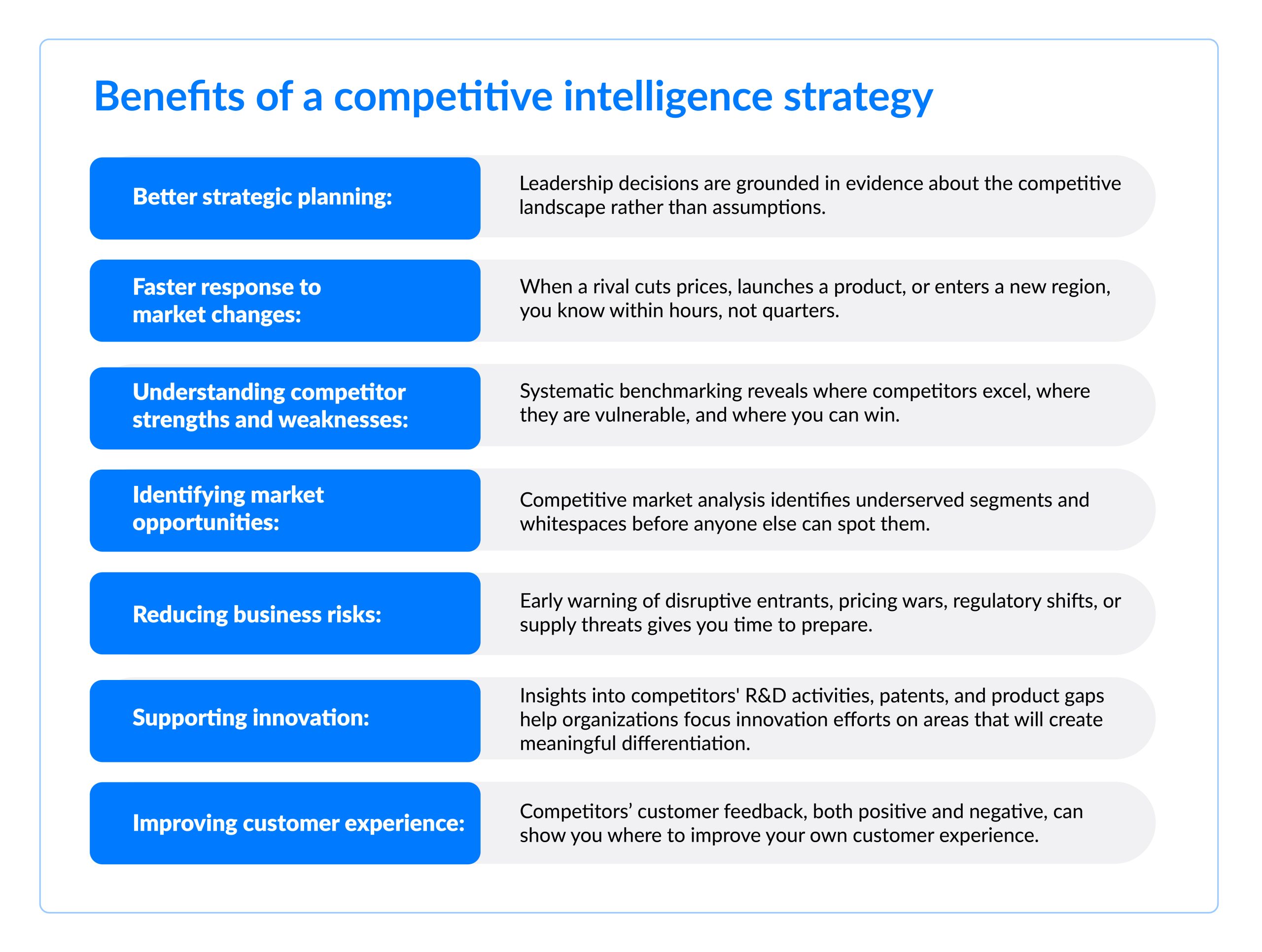
What’s making it grow so fast? The market understands that a strong competitive intelligence strategy delivers value across the business:
Competitive intelligence – The process
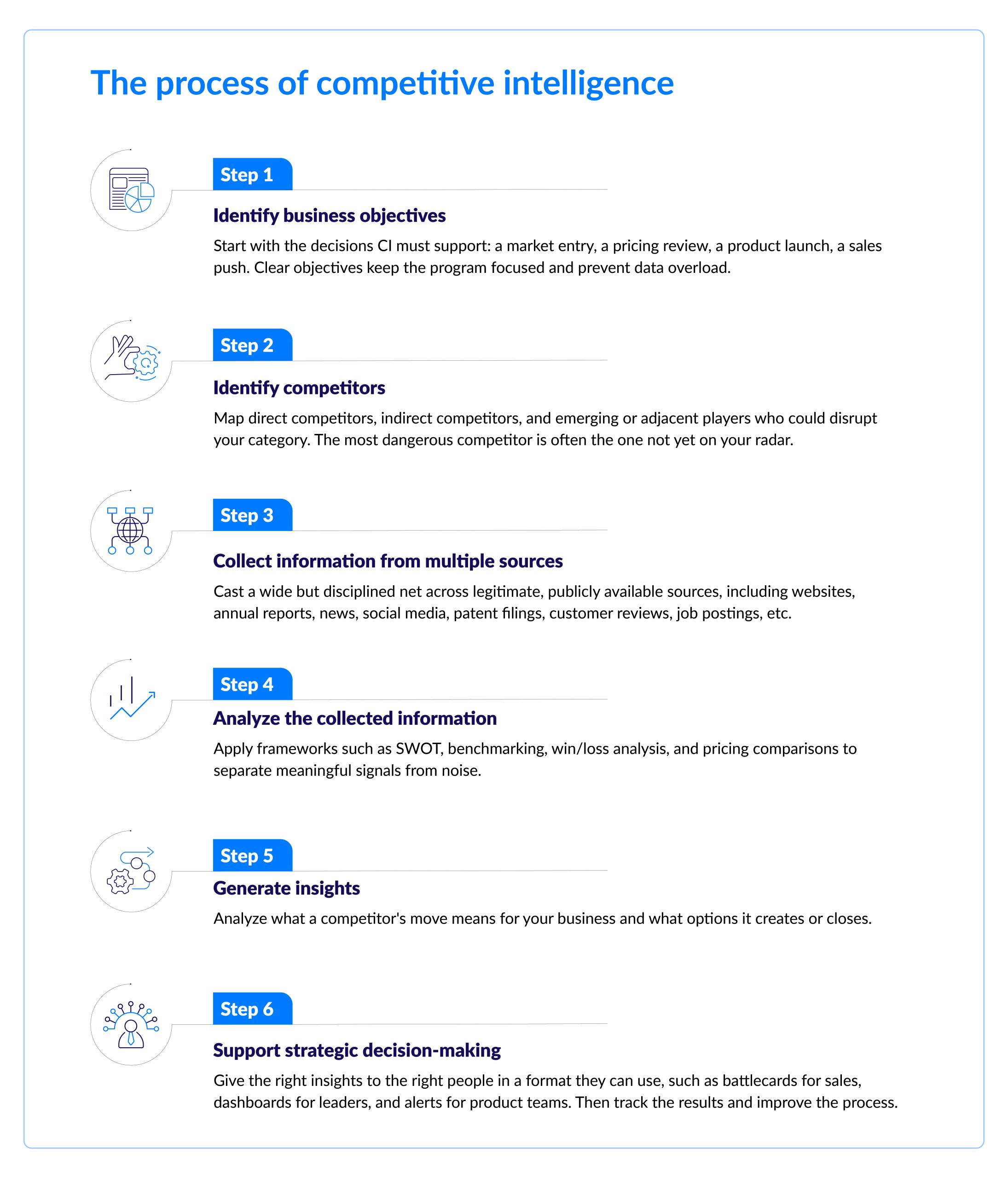
A mature competitive intelligence process is a repeatable competitive intelligence framework that runs as a continuous loop.
Competitive intelligence vs Market intelligence vs Competitor analysis
These three terms are often used interchangeably, but they answer different questions. Understanding market intelligence vs competitive intelligence, and where competitor analysis fits helps you deploy the right approach at the right time.
| Competitive intelligence | Market intelligence | Competitor analysis | |
|---|---|---|---|
| Primary focus | Competitors’ strategies, capabilities, and likely next moves | Customers, industries, and overall market conditions | Snapshot assessment of individual competitors |
| Scope | Ongoing, organization-wide program | Broad, market-level view | Narrow and entity-specific |
| Time horizon | Long-term strategic decisions | Medium to long-term market planning | Point-in-time, often project-specific |
| Typical questions | “What will Competitor X do next, and how should we respond?” | “How big is this market, and where is it heading?” | “How do Competitor X’s products and pricing compare to ours today?” |
| Typical outputs | Battlecards, early-warning alerts, strategic briefings | Market sizing, segmentation, trend reports | SWOT profiles, feature and pricing comparisons |
Benefits of competitive intelligence
A well-run CI program pays for itself across functions. The key benefits of competitive intelligence include:
- Better strategic planning: Build strategies based on evidence rather than instinct
- Faster market response: React to competitor moves in hours, not quarters
- Improved pricing strategies: Price with full visibility of the competitive landscape
- Stronger product development: Build what the market lacks, not what rivals already offer
- Better sales enablement: Arm sales teams with battlecards and objection-handling insights
- Increased market share: Win more head-to-head deals and capture whitespace
- Improved customer understanding: Learn from competitors’ customer feedback and churn signals
- Risk mitigation: Anticipate disruptions, price wars, and regulatory shifts before they become major risks
- Smarter investment decisions: Direct budgets toward validated opportunities
- Better forecasting: Use market trends and competitor activity to make more accurate predictions about future demand, pricing, and business performance
AI enhances each of these benefits through:
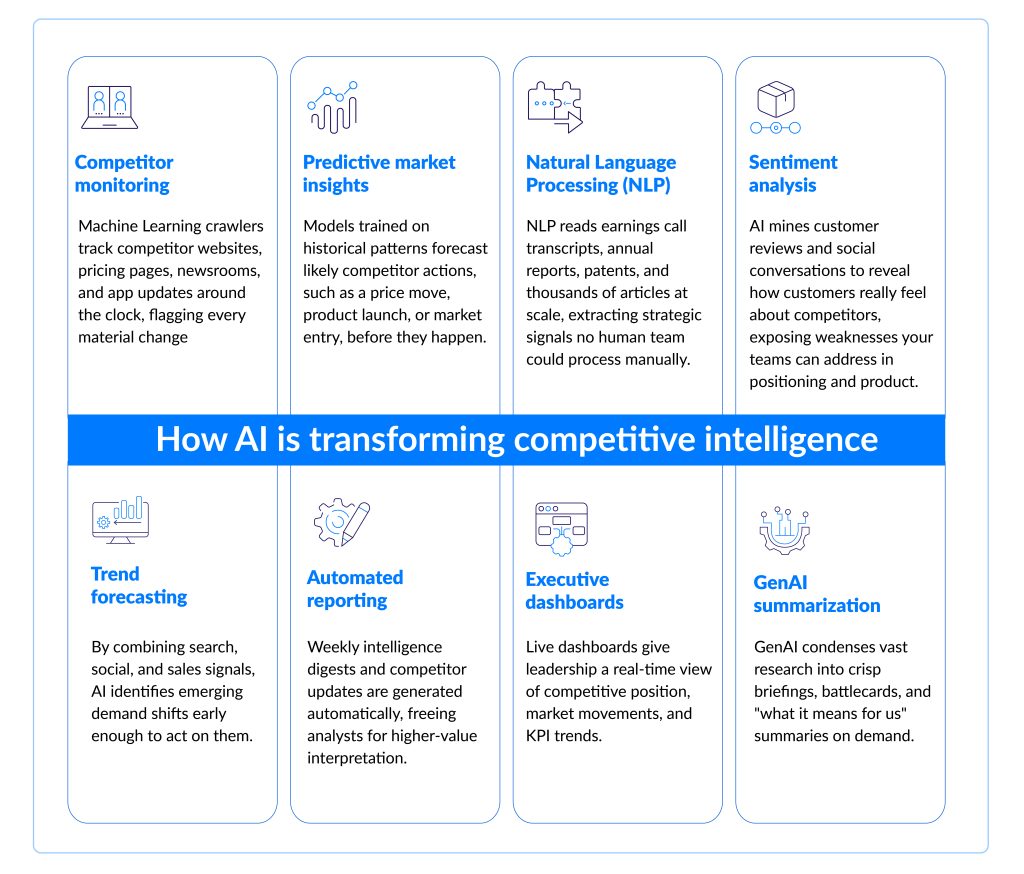
- Automated monitoring: Always-on tracking of competitor websites, pricing, news, and social channels
- Predictive analytics: Anticipating competitor moves and market shifts before they happen
- Trend forecasting: Spotting demand changes early through search, social, and review signals
- Opportunity identification: Surfacing whitespace and underserved segments automatically
- Real-time alerts: Instant notification the moment something material changes
- Faster reporting: Insights delivered in minutes instead of weeks
Popular competitive intelligence tools
The right competitive intelligence tools depend on what you need to track—digital presence, market conversations, financial signals, or all of the above. Popular options include:
- Crayon: AI-driven competitor tracking that captures competitor moves across the web and powers sales battlecards.
- Contify: A market and competitive intelligence platform that curates news, updates, and insights on competitors, customers, and industries.
- Similarweb: Provides digital intelligence on website traffic, audience behavior, engagement metrics, and market trends, helping businesses benchmark their online performance against competitors.
- Semrush: Visibility into competitors’ SEO, paid search, and content strategies.
- Ahrefs: Deep backlink, keyword, and content-gap analysis for competitive search intelligence.
- AlphaSense: AI-powered search across filings, earnings calls, broker research, and news for financial and market intelligence.
- Google Alerts: Free, simple monitoring of competitor mentions across the web.
- Brandwatch: social listening and consumer intelligence to track brand sentiment and share of voice.
- Tableau / Power BI: Visualization platforms that turn CI data into executive-ready dashboards.
- DataEdge360: AI-led competitive intelligence platform that simplifies competitor tracking, pricing, assortment, and inventory planning while integrating with ERP and CRM systems to deliver actionable global insights.
AI in competitive intelligence
In 2025, McKinsey’s State of AI research found that 78% of organizations used AI in at least one business function. Marketing is one of the functions with the highest and earliest adoption. Here is how AI is transforming the discipline:
Best practices for competitive intelligence
Apart from technology, discipline is one of the factors that can make or break the success of a program. These competitive intelligence best practices separate high-impact programs from shelfware:
- Define clear business goals: Anchor every intelligence effort to specific decisions, such as pricing, launches, or market entry, so insights always have a clear purpose.
- Use trusted data sources: Prioritize verified, credible, original sources over rumor and secondhand aggregation.
- Maintain ethical and legal standards: Collect only publicly available or legitimately obtained information. Never misrepresent your identity, induce breaches of confidentiality, or access proprietary data improperly.
- Continuously monitor competitors: Competitive advantage decays quickly; intelligence must be always-on, not annual.
- Combine quantitative and qualitative insights: Numbers show what is happening; qualitative signals, such as reviews, interviews, and job posts, explain why.
- Use AI responsibly: Validate AI-generated findings, watch for bias and hallucination, and keep human judgment in the loop for strategic calls.
- Share insights across business teams: Intelligence locked in one department creates no value. Distribute it to sales, marketing, product, and leadership in formats each can use.
- Review competitive intelligence regularly: Reassess objectives, competitors, sources, and KPIs on a set cadence to keep the program aligned with strategy.
It’s important to keep in mind that CI practice must comply with data privacy laws such as GDPR, CCPA, and India’s DPDP Act, respect intellectual property and confidentiality, and adhere to ethical guidelines. Ethical intelligence gathering helps reduce legal risk while protecting the trust your brand depends on.
Measuring the success of competitive intelligence
To prove and improve the value of CI, track KPIs such as:
- Market share growth
- Win/loss ratio
- Sales conversion rate
- Customer acquisition
- Customer retention
- Time to market
- Pricing competitiveness
- Brand sentiment
- Competitive benchmarking score
- Revenue growth
AI-powered dashboards make these KPIs continuously visible. Instead of waiting for quarterly reviews, leadership can monitor win rates, pricing gaps, sentiment shifts, and share movements in real time. Automated alerts can flag when any metric moves beyond its threshold.
Conclusion:
In markets where competitors move daily, and disruption arrives without warning, competitive intelligence is the foundation of confident, data-driven strategy. The organizations that win are those that see change first, understand it fastest, and act on it decisively.
That is exactly where eClerx helps. It enables organizations to monitor competitors continuously, unify internal and external market data into a single source of truth, and leverage AI-powered analytics to convert signals into strategy.
Our teams help enterprises identify market opportunities earlier, improve strategic decision-making at every level, and optimize pricing, products, and customer experience based on real competitive evidence while accelerating digital transformation through data-driven intelligence across the business.
Ready to turn market noise into competitive advantage? Explore eClerx’s AI-powered competitive intelligence and analytics solutions to turn real-time market signals into actionable intelligence and make smarter, faster decisions.
Frequently Asked Questions
Which tools are used for competitive intelligence?
Popular competitive intelligence tools include Crayon and Contify for competitor tracking, Similarweb for digital traffic intelligence, Semrush and Ahrefs for search and content intelligence, AlphaSense for financial and market research, Google Alerts and Brandwatch for mention and sentiment monitoring, and Tableau or Power BI for visualization. For enterprises looking for AI-powered digital shelf intelligence, competitive benchmarking, real-time monitoring, actionable insights, and customizable dashboards across online channels, they may consider eClerx Market360™.
How does AI improve competitive intelligence?
AI automates data collection across thousands of sources, applies NLP and sentiment analysis to unstructured content, detects trends in real time, and predicts likely competitor moves.
It also generates automated reports, executive dashboards, and GenAI-powered summaries, reducing intelligence cycles from weeks to minutes and enabling decisions based on current rather than historical information.
Is competitive intelligence legal and ethical?
Yes. Competitive intelligence is legal and ethical when it relies on publicly available or legitimately obtained information and complies with data privacy laws such as GDPR, CCPA, and India’s DPDP Act.
It is fundamentally different from corporate espionage, which involves illegal methods like hacking, misrepresentation, or theft of trade secrets. Following ethical frameworks such as SCIP’s code of conduct keeps programs fully compliant.
What industries benefit the most from competitive intelligence?
Industries with fast-moving competition benefit most, including retail and e-commerce, BFSI, telecom, healthcare, manufacturing, and technology.
That said, any organization operating in a contested market gains from competitive intelligence, because pricing pressure, digital disruption, and shifting customer expectations now affect every sector.
How often should competitive intelligence be performed?
Continuously. Competitive intelligence works best as an always-on program: automated monitoring runs daily, insights are reported weekly or monthly, and deeper strategic reviews are conducted quarterly.
AI-powered tools have made continuous monitoring practical and affordable, which is why one-off annual competitor studies are increasingly considered outdated.
Featured insights