Blog | 9 mins read
August 7, 2026

Key takeaways
- RPA is ideal for automating repetitive, rule-based tasks, while Agentic AI enables intelligent decision-making and adapts to dynamic business workflows.
- A hybrid approach that combines RPA with Agentic AI helps enterprises automate end-to-end processes more efficiently and at scale.
- Agentic AI enhances enterprise automation by enabling reasoning, collaboration between AI agents, and context-aware execution beyond traditional automation.
- Platforms like Roboworx CogniFlows empower organizations to orchestrate intelligent workflows, improve operational efficiency, and accelerate digital transformation
Businesses have spent years investing in automation to improve efficiency, reduce costs, and streamline operations. For many organizations, Robotic Process Automation (RPA) has been the foundation of these efforts, automating repetitive, rule-based tasks with software bots that mimic human actions.
However, enterprise processes are becoming increasingly dynamic. Organizations are dealing with unstructured data, evolving business rules, and complex workflows that require judgment rather than simple task execution. This has led to the rise of Agentic AI—a new approach to enterprise automation that combines reasoning, planning, and autonomous execution to handle work that traditional automation cannot.
Rather than replacing RPA entirely, Agentic AI extends automation into areas that previously required significant human intervention. Together, these technologies are reshaping how organizations approach business process automation, enabling intelligent, end-to-end workflows.
In this article, we’ll compare RPA vs Agentic AI, explore where each technology delivers the most value, and explain why many enterprises are adopting a hybrid automation strategy.mation strategy.
What is Robotic Process Automation (RPA)?
Robotic Process Automation (RPA) is a technology that uses software bots to automate repetitive, rule-based business tasks. These bots follow predefined instructions, interact with applications the same way humans do, and execute processes with speed and consistency.
Unlike AI, RPA doesn’t understand context or make decisions. It simply follows programmed workflows based on fixed rules. This makes robotic process automation software highly effective for processes that are stable, structured, and repetitive.
RPA is particularly valuable because it can often be implemented without replacing existing enterprise systems. Bots can work across legacy applications, ERP platforms, CRM systems, and desktop interfaces, allowing organizations to improve operational efficiency without major infrastructure changes.
Common use cases include:
- Invoice processing
- Data entry and validation
- Payroll processing
- Report generation
- Employee onboarding tasks
- Customer record updates
Because these activities rely on structured data and predictable workflows, RPA delivers faster processing, fewer manual errors, and lower operational costs. While RPA remains a critical component of workflow automation, its capabilities are limited when business processes become more dynamic or require judgment.
What is Agentic AI?
Agentic AI represents the next evolution of intelligent automation. Instead of simply following predefined rules, Agentic AI systems pursue goals, reason through problems, make decisions, and adapt their actions based on changing circumstances.
At the heart of Agentic AI are autonomous AI agents that can understand objectives, determine the best course of action, collaborate with other agents, and interact with enterprise systems to complete complex workflows.
Unlike traditional automation, Agentic AI can:
- Interpret structured and unstructured information
- Plan multi-step workflows
- Make context-aware decisions
- Learn from previous interactions
- Use external tools and enterprise applications
- Collaborate with multiple AI agents to accomplish complex objectives
For example, rather than simply extracting information from a customer document, an AI agent could analyze the document, determine missing information, request additional documentation, verify compliance requirements, escalate exceptions to human reviewers, and complete downstream processing automatically.
This ability to reason and adapt makes Agentic AI particularly valuable for modern AI workflow automation, where business processes rarely follow a perfectly predictable path.
RPA vs Agentic AI: Key differences
Although both technologies automate work, they solve fundamentally different problems.
Traditional RPA focuses on executing predefined tasks with speed and consistency. Agentic AI focuses on achieving business goals, even when workflows change or unexpected situations arise.
| Feature | RPA | Agentic AI |
|---|---|---|
| Automation | Rule-based | Goal-driven |
| Decision-making | No | Yes |
| Learning | No | Continuous |
| Unstructured data | Limited | Yes |
| Human intervention | High | Low |
| Exception handling | Limited | Dynamic |
| Multi-step planning | No | Yes |
| Adaptability | Low | High |
Rather than viewing RPA vs Agentic AI as competing technologies, organizations should think of them as complementary capabilities within a broader enterprise automation strategy.
When should you use RPA?
RPA continues to be one of the most effective solutions for predictable operational processes.
Organizations should consider RPA when:
- Business rules are clearly defined
- Data is highly structured
- Processes rarely change
- Large volumes of repetitive work need automation
- Speed and consistency are top priorities
For example, you could choose RPA for:
- Payroll calculations
- Invoice matching
- Regulatory report generation
- Employee data synchronization
- Order processing
- Routine compliance checks
These processes benefit from deterministic automation, where every step follows established business rules.
For these scenarios, RPA delivers excellent return on investment by reducing manual effort while maintaining high accuracy.
When should you use Agentic AI?
Agentic AI becomes valuable when workflows require flexibility, reasoning, or collaboration across multiple systems.
Organizations should consider Agentic AI when:
- Business decisions must be made during workflows
- Multiple enterprise systems need coordination
- Processes change frequently
- Large volumes of unstructured documents require analysis
- Human collaboration is necessary for approvals or exception handling
- Business rules evolve over time
Examples include:
- Insurance claims assessment
- Customer complaint resolution
- Loan application processing
- Compliance investigations
- Procurement approvals
- Knowledge-intensive customer support
More than simple automation, these scenarios require intelligent decision-making that adapts to changing conditions. This is where AI workflow automation significantly expands what organizations can automate.
Can RPA and Agentic AI work together?
Absolutely. In fact, many organizations are achieving the best results by combining both technologies into a single automation strategy. Rather than replacing existing RPA investments, Agentic AI enhances them.
A typical workflow might look like this:
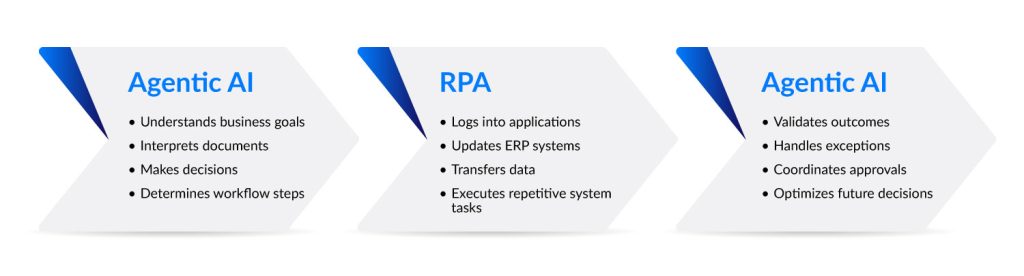
This hybrid approach combines the efficiency of RPA with the adaptability of Agentic AI, allowing organizations to automate complete business processes rather than isolated tasks.
As enterprises pursue digital transformation, this combination is becoming the foundation of modern enterprise automation.
Enterprise use cases
Across industries, organizations are moving from task automation toward intelligent workflow orchestration.
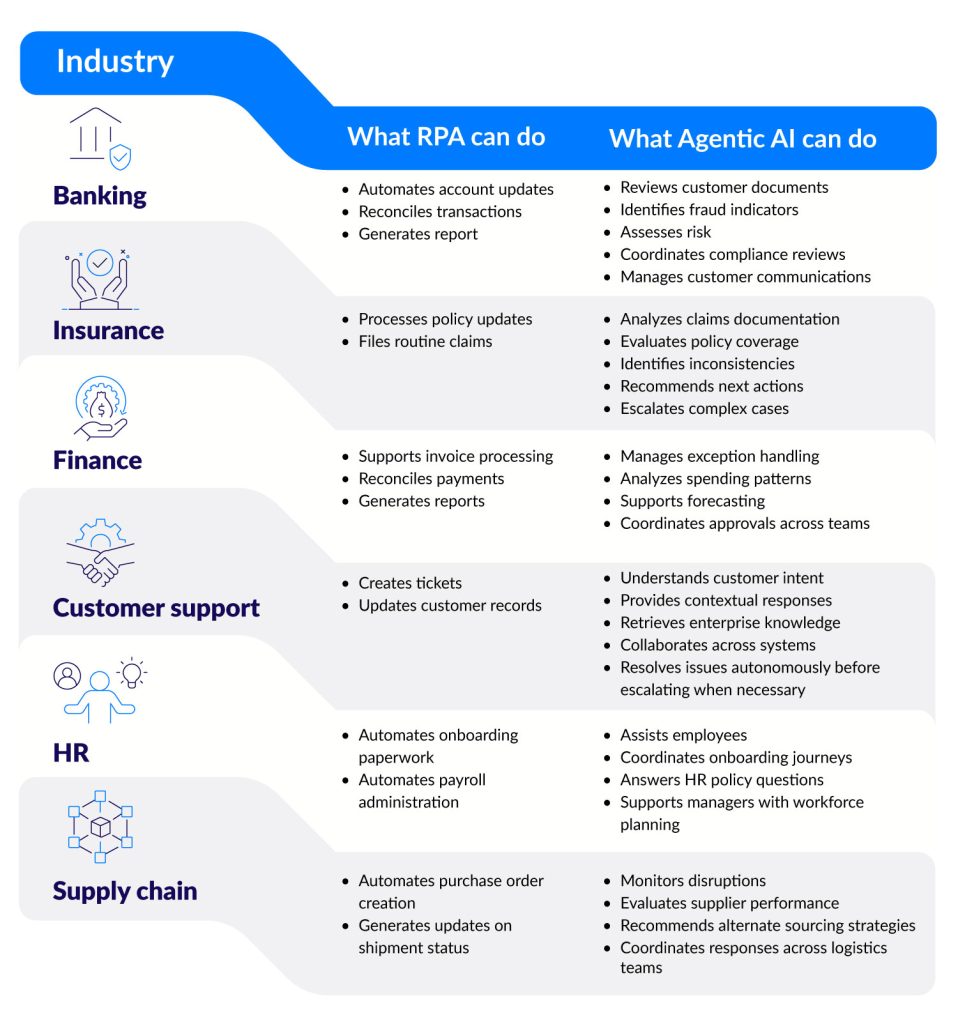
Across these industries, the evolution is clear: organizations are moving from automating individual tasks to orchestrating intelligent business outcomes.
Challenges
Despite their benefits, both technologies present implementation challenges, primarily:
- RPA limitations: RPA performs exceptionally well within predefined rules but struggles when processes change unexpectedly. Frequent workflow modifications can require extensive bot maintenance, limiting scalability.
- Agentic AI governance: Because Agentic AI makes decisions, organizations need governance frameworks that define accountability, transparency, and acceptable operating boundaries.
Apart from this, there are three major areas where organizations may see challenges:
- Security: Both technologies require secure access to enterprise systems and sensitive business data. Strong identity management, role-based permissions, and audit capabilities are essential.
- Human oversight: Even autonomous systems require human involvement for critical decisions, regulatory compliance, and exception management. Human-in-the-loop workflows help balance efficiency with accountability.
- Integration: Modern enterprises operate across ERP systems, CRM platforms, HRMS applications, APIs, cloud services, and legacy environments. Successfully integrating automation across these systems remains a significant challenge without the right orchestration platform.
How Roboworx CogniFlows helps enterprises move beyond traditional automation
While traditional RPA focuses on task execution, modern enterprises increasingly need platforms that orchestrate intelligent workflows across people, AI agents, and enterprise systems.
Roboworx CogniFlows enables organizations to move beyond isolated automation by combining AI reasoning, orchestration, governance, and enterprise connectivity within a unified platform.
Here are some of the benefits:
- Intelligent workflow orchestration: Coordinate AI agents, business rules, approvals, and enterprise workflows from a centralized orchestration layer that adapts to changing business conditions.
- AI-driven decision making: Handle complex scenarios where predefined rules are insufficient by enabling AI agents to evaluate context, reason through decisions, and determine appropriate actions.
- Human-in-the-loop governance: Maintain oversight by allowing employees to review, approve, or intervene in high-risk decisions while preserving compliance and accountability.
- Enterprise integrations: Connect seamlessly with ERP, CRM, HRMS, ticketing platforms, APIs, databases, and legacy enterprise applications to automate workflows across the organization.
- Multi-agent collaboration: Enable specialized AI agents to collaborate on complex processes, sharing information and coordinating tasks to achieve broader business objectives.
- Analytics and monitoring: Monitor workflow performance, identify bottlenecks, track business outcomes, and continuously optimize automation initiatives with actionable insights.
Roboworx CogniFlows helps organizations evolve from task-based automation to intelligent, goal-driven enterprise workflows by combining AI reasoning, orchestration, governance, and enterprise integrations.
Conclusion
The discussion around RPA vs Agentic AI is not about choosing one technology over the other. Each serves a different purpose within a modern automation strategy.
RPA continues to deliver exceptional value for repetitive, rule-based processes involving structured data and predictable workflows. It remains an essential tool for improving operational efficiency and reducing manual effort.
Agentic AI expands the possibilities of business process automation by enabling reasoning, decision-making, and adaptive execution across dynamic enterprise workflows. Its ability to collaborate, understand context, and coordinate multiple systems makes it well suited for today’s increasingly complex business environments.
For many organizations, the greatest value comes from combining both technologies. By integrating RPA with Agentic AI, enterprises can automate entire business processes, improve agility, and build a more intelligent foundation for digital transformation.
Frequently Asked Questions
What is the difference between RPA and Agentic AI?
RPA automates repetitive, rule-based tasks using predefined scripts, while Agentic AI uses autonomous AI agents that can reason, plan, make decisions, and adapt to changing business conditions.
Can RPA and Agentic AI work together?
Yes. Many organizations combine RPA with Agentic AI to automate end-to-end workflows. Agentic AI manages decision-making and orchestration, while RPA executes repetitive tasks across enterprise systems.
When should businesses use Agentic AI instead of RPA?
Businesses should use Agentic AI when workflows involve complex decisions, changing business rules, multiple enterprise systems, unstructured data, or collaboration between people and AI.
What are the limitations of RPA?
RPA works best with structured, rule-based processes. It has limited ability to handle exceptions, understand context, process unstructured information, or adapt when workflows change.
What should organizations look for in an enterprise automation platform?
An enterprise automation platform should support intelligent workflow orchestration, AI-driven decision-making, human oversight, enterprise integrations, analytics, governance, and the ability to combine RPA with Agentic AI for scalable, end-to-end automation. eClerx’s Roboworx CogniFlows brings these elements together through Agentic AI and autonomous workflow execution, helping enterprises streamline complex processes while maintaining the oversight and integrations they need.
Featured insights