Blog | 8 mins read
January 23, 2026

Today’s digital experiences are more layered, emotional, and fast moving than ever before. Marketers and analysts can no longer afford to rely solely on clickstream or time-on-page data to understand what’s truly resonating. Customers interact through multiple modes – tapping, scrolling, hovering, watching and each of these actions carries subtle intent.
At eClerx, we’re helping brands transform customer experiences by monitoring these interactions and allowing our clients to scale digital commerce through real time personalization.
Key takeaways
- Why single-source clickstream data no longer tells the full story of customer behavior.
- What multimodal AI is and how it transforms customer engagement.
- How real-time customer engagement works when scroll, cursor, video, and gaze signals are read together.
- How predictive models flag churn risk and score conversion likelihood before users drop off.
- How businesses turn customer engagement analytics into personalized experiences and concrete actions.
- Why AI-powered brand engagement matters more as third-party cookies disappear.
- How eClerx helps brands scale digital commerce through real-time personalization.
Beyond the click: Why single-source clickstream data isn’t enough anymore
Clickstream data is a great starting point—it shows where users click, which pages they visit, and how long they stay. But it’s only one piece of a much bigger puzzle.
To truly understand your audience, you need to go deeper. Here’s why:
- Discover the “why” behind the click: A click alone doesn’t reveal intent. Was the user confident and engaged, or confused and uncertain? Did they click by choice or by accident?
- See the moments between clicks: Scroll patterns, cursor movement, hover pauses, and even “rage clicks” reveal emotion and engagement levels that clickstream alone can’t capture.
- Replace assumptions with clarity: When data lacks depth, it’s tempting to fill the gaps with guesswork. Richer behavioral insights prevent bias, ensuring decisions are grounded in reality—not assumptions.
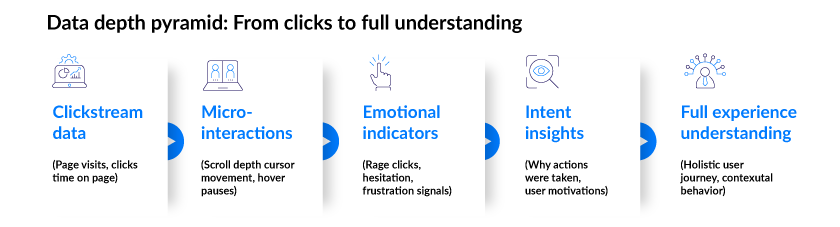
When you combine clickstream data with deeper behavioral signals, you move from simply tracking actions to truly understanding experiences – and that’s where transformation happens.
For example: eClerx partnered with a banking organization to help reduce the 65% bounce rate on its account comparison page. Click data alone didn’t reveal the issue. When we added scroll depth and rage click tracking, it became clear users were repeatedly interacting with a non-clickable element mid-page, then leaving. Once CTAs were repositioned and clarified with sub-texts, the bounce rate dropped and engagement improved significantly.
How multimodal AI transforms customer engagement
Multimodal AI is exactly what it sounds like: AI that can read several types of signals at the same time, such as clicks, scrolls, cursor movements, video behavior, voice, text, and even gaze. Instead of looking at each signal separately, it interprets them together. One signal is just a data point, but when you layer several signals together, they start to reveal a shift or a pattern. A deep scroll on its own could mean interest, or it could mean someone hunting for information they can’t find. Add a slowing cursor and a pause over the pricing table, and the picture sharpens into genuine consideration. Add a rage click, and it flips to frustration.
Signals in motion: Real-time experience mapping
What if your analytics could detect frustration before a user even bounces? Multimodal AI lets you build real-time experience maps that combine scroll depth, dwell time, video watch behavior, cursor velocity, and eye tracking. These signals feed into models that predict drop-off likelihood, interest level, or conversion probability – while the user is still active on-site.
This isn’t just attribution, it’s intervention.
Imagine being able to suppress exit modals for high-intent users, but proactively offer support to those showing signs of confusion.
A durable goods retailer used GA4 scroll depth and video engagement data to optimize their product category landing page. By identifying key sections where users paused or dropped off, they restructured content flow and repositioned video explainers higher on the page. The result? A 17% drop in bounce rate and a 22% lift in click-throughs to product detail pages.
Real-time multimodal AI for personalized customer experiences
Real-time customer engagement only works when a system can make decisions before a user loses patience, which is usually just a few seconds. That is where multimodal AI makes a difference because the models can assess intent as different signals come in; personalization no longer has to wait for the customer’s next visit. It can happen during the current session.
What does this look like in practice? Here are a few instances:
- A first-time visitor who is quickly skimming the page might see a simpler layout with fewer choices.
- A returning user who spends time reviewing a product spec sheet might see a comparison module instead of a discount pop-up.
- Someone showing clear signs that they are about to leave might get proactive chat support before they hit the back button.
AI-powered customer engagement uses the same micro-signals described above, such as scroll speed, time spent on a page, and video completion, and applies them to the individual session.
Predictive CX models: A new marketing arsenal turning insights to action
Predictive modelling becomes more accurate when data types contextualize each other. For example, a user scrolling deeply but never clicking could signal informational intent, while video engagement paired with gaze analysis might reveal emotional resonance with a product.
Multimodal AI is predictive, not just interpretive. The goal is to move from “what happened” to “what will happen” and “what should we do about it?” If a user has a history of fast-scrolling, rage clicking, and bouncing within 30 seconds, AI can flag them in real time and trigger smoother experiences—be it simplified UI, or escalated chat support.
We have seen multiple use cases across user journeys where businesses can implement these models and make multi-million-dollar ROI.
- Churn predictors: Users who repeatedly pause videos and revisit pricing pages
- Conversion likelihood scores: Based on depth of interaction across modalities
- Personalization engines: Adapt UI, content, offers in real time
Turning multimodal AI insights into business actions
An insight that simply sits in a dashboard is of no use if it doesn’t help teams make decisions and take action. This is where multimodal signals can add value. Here are some of the use cases:
For marketing teams, this means making campaign and content decisions based on what actually held people’s attention, not just what they clicked.
For product teams, it means identifying and fixing the exact parts of a page where users hesitate and eventually leave.
For CX teams, it means getting help to customers who need it before they even have to raise a complaint.
And for leadership, customer engagement analytics based on multimodal data can provide a much more honest view of brand health than vanity metrics ever could.
One useful rule is to connect every signal to a decision before you start tracking it. For example, if a user scrolls deeply without clicking, that could indicate informational intent. This is where you decide your next step—whether to suggest a guide, a comparison tool, or a prompt to connect with sales.
AI-powered brand engagement works best when the full loop is connected: signal, interpretation, action, and measurement. Skip the last two steps, and you have simply built an articulate system to watch customers leave.
From integration to impact: Putting multimodal AI to work
Typically, a multimodal engine aimed at real time personalization works by unifying all behavioral data in BigQuery or a CDP, then enriching it with session replays or chat logs.
From there, machine-learning models are trained to segment users based on engagement quality and trigger timely interventions—like personalizing product banners or reordering content blocks or triggering exit modals based on intent prediction.
Operationalizing multimodal AI
With the right setup, multimodal AI stops just being a dashboard feature, enabling marketers to shift from reactive reporting to proactive personalization, offering support or content dynamically, based on micro-signals.
For example, a B2C client used scroll + click + chatbot data to identify and recover 18% of high-exit users from the cart page.
To get started, a business can begin by identifying clear use cases before scaling up for optimal ROI, like reducing cart abandonment or improving lead form completions.
The next step would be to feed in a mix of engagement signals—such as video completion rates, scroll velocity, and chatbot queries.
Finally, apply the AI outputs to personalize journeys.
Why this matters now: The competitive edge
Experience has overtaken price and product as the key battleground. AI-driven engagement insights are helping brands deliver emotionally resonant and in-the-moment responses.
Leading brands are embedding AI into decision systems—fueling faster learning cycles and better personalization. Waiting means falling behind.
And with the end of third-party cookies, deeper interpretation of on-site behavior—like gaze, scroll depth, or video replays—will be the holy grail for intent modeling.
Making it actionable: Cross-team buy-in for smarter engagement
To make multimodal AI actionable, cross-functional collaboration is key. Product, marketing, and analytics teams must work together to:
- Align on key engagement signals
- Define what ‘good’ engagement looks like
- Build real-time triggers and feedback loops
If you’re still relying on single-source engagement metrics, you’re missing the full picture. Multimodal AI is not about replacing marketers—it is about empowering them with better foresight and ability to make smarter decisions faster.
Ready to turn micro-signals into macro impact? Click the link below to book a free consultation.
Frequently Asked Questions
What is multimodal AI and how does it improve customer engagement?
Multimodal AI is artificial intelligence that can understand different types of data at the same time. This includes clicks, scrolls, cursor movements, video behavior, text, and even gaze, rather than analyzing each one separately.
For customer engagement, combining these signals helps reveal user intent more clearly. A click tells you that something happened, but the signals around it can show whether the user was confident, curious, or frustrated when they clicked.
How can multimodal AI analyze customer interactions in real time?
Behavioral signals are collected in a unified data layer, such as a CDP or a data warehouse like BigQuery. Trained AI models analyze these signals as they come in. This allows the system to predict whether a customer is likely to leave or convert while they are still on the page and respond within seconds, such as by simplifying the interface or opening a chat window.
How does multimodal AI help brands understand customer behavior?
It answers the question clickstream can’t: Why? Scroll depth tells you how far interest carried. A slowing, hovering cursor usually means hesitation. Rage clicks are frustration. Video watch patterns show what actually held someone’s attention. Any one of these on its own is a guess, but when read together, they explain what the person was trying to do and where the experience got in their way.
What types of customer data can multimodal AI analyze?
Almost anything a session throws off. Clicks and page views, but also scroll depth and speed, cursor movement, hover time, rage clicks, how much of a video someone actually watched, dwell time, chatbot conversations, session replays, and (if the setup supports it) gaze or eye-tracking data. None of these is the prize. The value is in the overlap, because each signal makes the others easier to read.
How can businesses use multimodal AI insights to personalize customer experiences?
Pick one problem and start there–cart abandonment and half-finished lead forms are the usual suspects. Once the signals are flowing, let them drive small live adjustments: reorder the content, change the offer, drop the exit pop-up for someone who’s clearly about to buy, send help to someone who looks stuck. It doesn’t take exotic data either. One B2C brand pulled back 18% of the users abandoning its cart page with nothing more than scroll, click, and chatbot data.
Featured insights